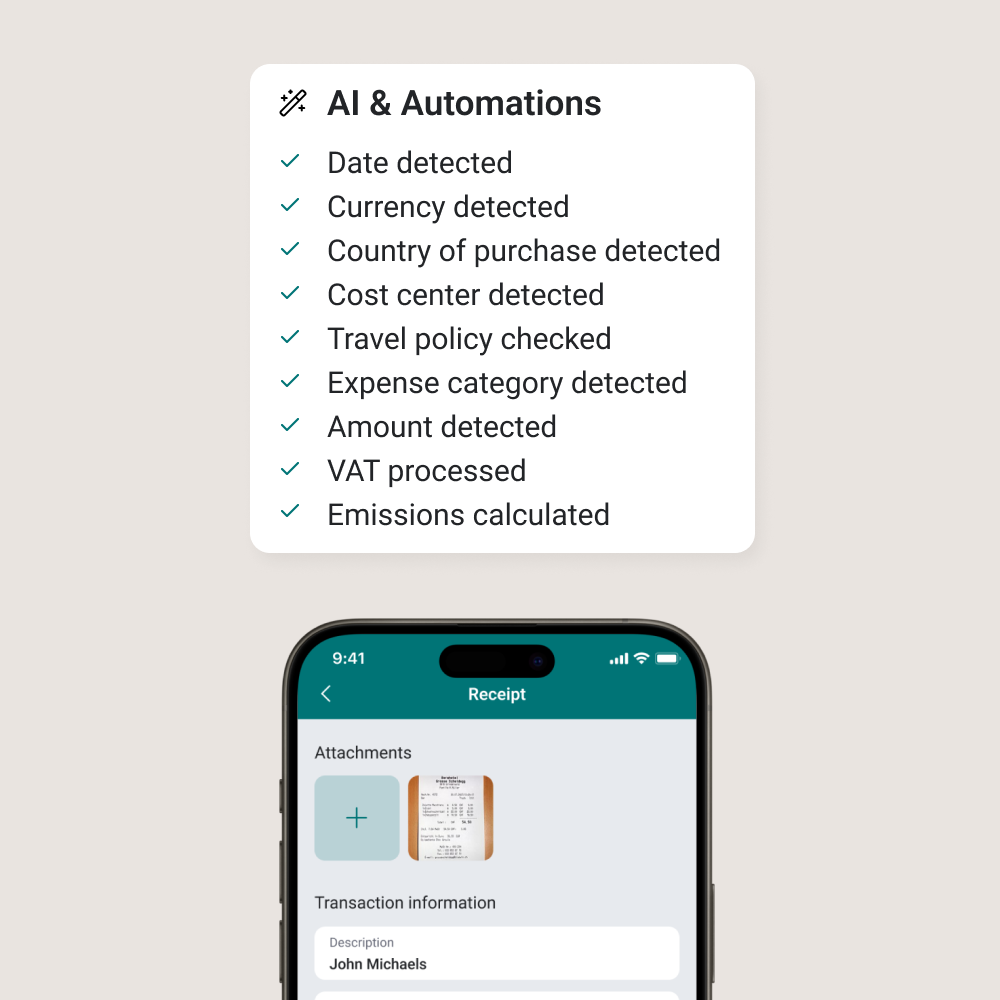


Mileage reimbursement software can automate a meaningful portion of your ESG carbon data, but not all of it. These platforms capture employee-driven road travel, calculate CO2 emissions per trip using vehicle type and distance, and produce structured records that feed into sustainability reporting. The gap lies in what they do not cover: flights, rail, hotels, and other Scope 3 travel categories that sit outside the mileage reimbursement workflow. The sections below unpack exactly what the software captures, how the calculations work, and what finance teams should look for when evaluating tools for ESG purposes.
What ESG carbon data can mileage reimbursement software actually capture?
Mileage reimbursement software captures CO2 emissions data from employee road travel reimbursed through the business. This includes personal vehicle trips, company car journeys, and, in some platforms, electric versus combustion vehicle distinctions. The data is structured, timestamped, and tied to individual employees, making it directly usable for carbon emissions tracking at the organizational level.
More specifically, the software logs the distance of each trip, the vehicle type or engine category, and the purpose of the journey. From those inputs, it derives an estimated CO2 figure per trip using established emission factors. Because every reimbursement claim goes through the system, the resulting dataset is comprehensive for the category it covers, with no manual data collection required.
What the software does not capture is equally important to understand. Air travel, train journeys, taxi and rideshare costs, hotel stays, and other travel expenses managed outside the mileage workflow do not appear in these records. Finance teams building a full ESG picture need to treat mileage reimbursement data as one input among several, not a complete carbon accounting solution.
How does mileage reimbursement software calculate CO2 emissions?
Mileage reimbursement software calculates CO2 emissions by multiplying the recorded trip distance by an emission factor assigned to the vehicle type. Emission factors are typically drawn from national or international standards, such as those published by the IPCC or local tax authorities, and vary depending on whether the vehicle runs on petrol, diesel, hybrid, or electric power.
The quality of the CO2 output depends on how granular the vehicle data is. Basic platforms apply a single average emission factor per vehicle category. More sophisticated tools allow employees to specify engine size, fuel type, or even a specific vehicle model, producing a more accurate per-kilometre carbon figure. Some platforms also apply different factors for urban versus motorway driving, though this level of precision is less common.
It is worth noting that electric vehicles still carry an associated emissions figure in most calculation models, reflecting the carbon intensity of the electricity grid used to charge them. A well-designed mileage reimbursement tool should account for this rather than defaulting to zero for EVs, which would understate actual emissions in most markets.
What’s the difference between mileage data and full Scope 3 travel emissions?
Mileage data covers a subset of Scope 3 Category 6 emissions, which the GHG Protocol defines as business travel. Full Scope 3 travel emissions include all modes of transport used for business purposes, including flights, trains, ferries, taxis, and rental cars, as well as upstream emissions from fuel production. Mileage reimbursement software only addresses the road travel component where employees are reimbursed per kilometre.
This distinction matters for ESG reporting because organizations with significant air travel or rail usage will have large Scope 3 travel footprints that mileage data alone cannot represent. A company whose sales team drives extensively may find that mileage reimbursement software covers the majority of its business travel emissions. A company with frequent international flights will find the opposite.
Finance teams should map their actual travel patterns before deciding how central mileage reimbursement data is to their carbon reporting. If road travel represents a small share of total business travel, the software’s ESG contribution is limited. If it represents the majority, the automated data collection and CO2 calculation features become genuinely valuable for sustainability reporting.
Can mileage reimbursement data feed directly into ESG reporting frameworks?
Yes, mileage reimbursement data can feed directly into ESG reporting frameworks, provided the software exports structured data in a format compatible with your reporting workflow. The GHG Protocol, CDP, and GRI all require Scope 3 business travel data to be reported in tonnes of CO2 equivalent, and mileage reimbursement software that calculates per-trip emissions can produce exactly that output.
The practical question is integration. Some platforms export raw mileage and emissions data as CSV or Excel files, which require manual aggregation before they reach a sustainability report. Others connect via API to ERP or financial systems, allowing carbon data to flow automatically into the same consolidation layer used for financial reporting. The more automated the data path, the lower the risk of transcription errors and the easier it is to audit the figures.
For companies subject to the EU Corporate Sustainability Reporting Directive, which requires detailed Scope 3 disclosures, having auditable, system-generated mileage and emissions records is preferable to estimates derived from reimbursement totals. The software creates a verifiable trail from individual trip to aggregated carbon figure, which supports the assurance requirements that CSRD introduces.
What should finance teams look for in mileage software for ESG purposes?
Finance teams evaluating mileage reimbursement software for ESG purposes should prioritise four capabilities: granular vehicle emission factors, structured CO2 output per trip, export or integration options compatible with ESG reporting tools, and audit trails that support third-party assurance. Without these, the software produces reimbursement records but not carbon data in any meaningful sense.
- Granular emission factors: The software should apply different CO2 rates by fuel type, engine size, and ideally vehicle model, rather than a single average. This improves accuracy and defensibility when figures are reviewed by auditors or disclosed publicly.
- Structured CO2 output: Each trip record should include a calculated emissions figure, not just distance and reimbursement amount. This allows direct aggregation for reporting without additional calculation steps.
- Integration with financial and ERP systems: Carbon data that lives in a standalone reimbursement tool is harder to consolidate. Look for platforms that connect to the systems your finance team already uses for reporting.
- Audit-ready records: Every trip should be traceable to an individual employee, date, route, vehicle type, and derived CO2 figure. This supports both internal review and external assurance.
- Country-specific compliance: For international organizations, the software should handle different national emission factors and reimbursement rules without manual workarounds.
Platforms like Bezala address several of these requirements through integrated map-based mileage tracking, automated per-trip calculations, and deep connections to ERP and financial systems. For finance teams managing employees across multiple countries, the ability to configure country-level settings while maintaining a single consolidated data view is particularly relevant when preparing group-level ESG disclosures.
The broader principle is that mileage reimbursement software earns its place in an ESG workflow only when it produces carbon data as a byproduct of normal expense processing, without requiring finance teams to run separate collection exercises. If the software requires manual input to generate emissions figures, the efficiency case for using it in sustainability reporting largely disappears.
This content was generated with the help of AI and it may contain mistakes