

To calculate your business travel carbon footprint, multiply the distance traveled by the relevant emission factor for each transport mode. The result gives you a CO2 equivalent figure (CO2e) that accounts for all greenhouse gases produced by that journey. For most companies, this calculation is repeated across every trip taken by every employee, then aggregated into a total annual figure.
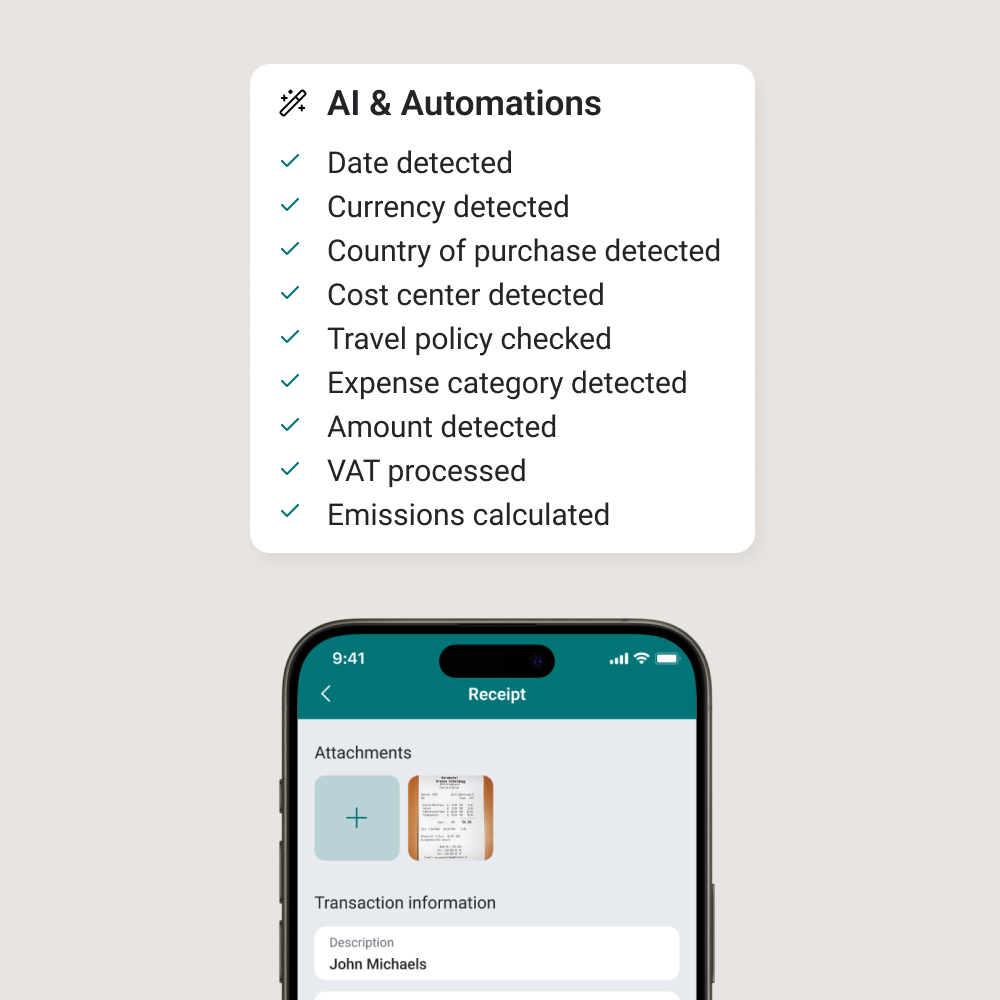
Platforms like Bezala make this easier in practice. As an international travel expense platform, Bezala calculates each trip’s emissions automatically as part of the expense workflow — factoring in details such as flight distance and the type of flight for air travel, and the vehicle’s propulsion type (petrol, diesel, hybrid, or electric) for mileage-based car trips. This means the data needed for emissions reporting is captured at the source, without a separate manual data-gathering exercise.
The accuracy of the result depends on the quality of your input data and the emission factors you apply. Different transport modes, travel classes, and fuel types all produce different emissions, so a single formula is rarely enough on its own. The sections below walk through each element of the calculation in detail.
What data do you need to calculate travel emissions?
To calculate business travel emissions, you need three core inputs for each trip: the mode of transport, the distance traveled, and any relevant modifiers such as travel class or vehicle type. Without these, even the best emission factor cannot produce a meaningful result.
In practice, gathering this data is often the hardest part of the process. Most companies piece it together from booking systems, expense reports, and employee submissions. The more granular the data, the more accurate the output. Here is what to collect for each common travel type:
- Flights: Origin and destination airports, cabin class (economy, business, first), and whether the route is short-haul or long-haul
- Rail: Origin and destination stations, and whether the train is diesel or electric
- Car travel: Distance driven, fuel type (petrol, diesel, electric, hybrid), and whether the car is personal or a company vehicle
- Taxis and rideshares: Distance traveled and vehicle type where available
- Ferries and coaches: Route distance and vessel or vehicle category
If exact distances are unavailable, great-circle distance calculators or mapping tools can estimate route lengths. Many companies also use booking platform exports as their primary data source, though these often require cleaning and standardization before they can be used in a calculation.
How do emission factors work for different transport modes?
Emission factors are standardized values that express how much CO2 equivalent is produced per unit of travel, typically per passenger kilometer (gCO2e/pkm). Each transport mode has its own factor, and within each mode, factors vary further based on vehicle type, fuel source, and occupancy assumptions.
Widely used emission factor databases include the UK Government’s conversion factors, published annually by the Department for Energy Security and Net Zero (DESNZ), the International Energy Agency (IEA), and the ICAO Carbon Emissions Calculator for aviation. The European Environment Agency also publishes mode-specific figures. These databases are updated regularly as vehicle fleets and energy grids become cleaner, so using the most current version matters.
As a general illustration of how transport modes compare, flights tend to carry higher per-kilometer emission factors than rail, particularly when radiative forcing is included. Private car travel sits somewhere in between, depending heavily on the number of passengers sharing the vehicle. Electric rail powered by a clean grid produces the lowest emissions per kilometer of any common business travel mode. These relative positions are widely accepted across emissions reporting frameworks, though exact figures shift with each database update.
What is the formula for calculating business travel CO2?
The standard formula for calculating business travel CO2 is: Distance (km) × Emission Factor (gCO2e/pkm) = Emissions (gCO2e). Divide the result by 1,000 to convert grams to kilograms, or by 1,000,000 to reach tonnes of CO2 equivalent, which is the unit most commonly used in corporate reporting.
For a full business travel carbon footprint, you apply this formula to every trip across every mode, then sum the results. In a structured format:
- List every trip taken during the reporting period
- Assign each trip a transport mode and distance
- Apply the appropriate emission factor from a recognized database
- Multiply distance by emission factor to get emissions per trip
- Sum all trip emissions for the total footprint
For flights, many frameworks recommend including a radiative forcing index (RFI) multiplier to account for the additional warming effect of contrails and other high-altitude impacts. The multiplier varies by source, but applying one produces a more complete picture of aviation’s climate impact than using the direct CO2 figure alone.
How does flight class affect carbon footprint calculations?
Flight class significantly affects carbon footprint calculations because business and first-class seats occupy more physical space on the aircraft, which means each passenger is allocated a larger share of the plane’s total emissions. On a long-haul route, a business-class seat typically produces around three times more CO2e per journey than an economy seat on the same flight; the multiplier is generally smaller on short-haul routes, where cabin layouts differ less between classes.
This adjustment is built into most recognized emission factor frameworks. The logic is straightforward: if a premium seat takes up more floor space than an economy seat, that passenger bears a proportionally larger share of the flight’s fuel consumption and resulting emissions. First-class seats, which are larger still, carry an even higher multiplier.
For companies where senior employees routinely fly business class for long-haul routes, this can substantially inflate the overall corporate travel carbon footprint compared to a workforce traveling predominantly in economy. It also means that a policy shift on travel class can have a measurable impact on reported emissions without reducing the number of trips taken.
What tools and calculators can companies use to measure travel emissions?
Companies can use a range of tools to measure travel emissions, from free online calculators to integrated expense management platforms that automate the process. The right choice depends on the volume of travel, reporting requirements, and how tightly the calculation needs to connect to financial data.
Free and publicly available calculators
The ICAO Carbon Emissions Calculator is the most widely referenced free tool for flight emissions. The UK Government’s greenhouse gas conversion factors, published annually by DESNZ, provide emission factors that can be applied manually in spreadsheets across all transport modes. The atmosfair and myclimate calculators are also commonly used for flight-specific estimates.
Integrated expense and travel management platforms
For companies managing a high volume of trips, manual calculation quickly becomes impractical. Expense management platforms that capture trip data at the point of submission can automate the emission calculation by applying emission factors in the background. This approach is more accurate and consistent than retrospective data gathering, because the transport mode, distance, and class are recorded when the expense is submitted. Platforms like Bezala, which capture mileage, transport type, and travel details as part of the expense workflow, are well positioned to feed this kind of automated calculation without requiring a separate data collection process.
Dedicated sustainability reporting tools such as Sweep, Watershed, and Plan A also integrate with travel data sources and apply recognized methodologies to produce audit-ready emissions reports aligned with frameworks like the GHG Protocol or CDP.
How should businesses report and reduce their travel carbon footprint?
Businesses should report travel emissions under Scope 3, Category 6 (business travel) of the GHG Protocol, using CO2 equivalent figures aggregated by transport mode. Reporting should cover the full calendar or financial year, use emission factors from a recognized and consistently applied source, and disclose any methodology assumptions such as whether radiative forcing is included for aviation.
Reporting best practices
Consistency matters more than perfection in early-stage reporting. Using the same emission factor database year over year allows meaningful comparison across periods. Disclosing the data sources, any gaps in coverage, and the boundaries of what is included builds credibility with stakeholders. Many companies align their travel emissions reporting with voluntary frameworks such as CDP and the Science Based Targets initiative (SBTi), both of which expect Scope 3 disclosure as part of their target-setting and reporting commitments. The EU’s Corporate Sustainability Reporting Directive (CSRD) also covers Scope 3 for companies within its scope — but that scope changed significantly under the 2026 Omnibus I simplification package, which raised the threshold to companies with more than 1,000 employees and over €450 million in turnover, delayed reporting for many mid-sized companies by two years, and allows in-scope companies to phase in value-chain (Scope 3) data over up to three years. Companies should check their current status under the revised rules rather than assume the original CSRD timeline still applies.
Practical reduction strategies
Reducing corporate travel CO2 does not require eliminating travel altogether. The most effective strategies target the highest-emission trips first. Long-haul flights in premium cabins produce the most emissions per trip, so policies that require economy class for shorter routes or set distance thresholds before air travel is approved can deliver meaningful reductions. Rail substitution for journeys under a few hours is another high-impact lever, particularly in Europe where intercity rail networks are well developed. Virtual meeting policies that replace routine travel with video calls address the volume of low-value trips. For unavoidable emissions, high-quality carbon-offsetting or removal projects can be used to neutralize what cannot be eliminated, though most reporting frameworks treat offsetting as a complement to reduction rather than a substitute for it.
This content was generated with the help of AI and it may contain mistakes