
To choose the right corporate card for your company, start by matching the card type to how your business actually spends: consider whether you need centralized control or individual employee cards, what spending limits and approval workflows you require, and whether the card integrates with your existing accounting or expense management software. The right choice depends on your company’s size, geographic footprint, and your finance team’s reporting needs. The questions below walk through every major decision point, from card types and fees to international features and software integration.
What types of corporate cards are available for businesses?
Corporate cards fall into three main categories: charge cards, credit cards, and prepaid or virtual cards. Charge cards require the full balance to be settled each month, credit cards allow revolving balances, and prepaid cards are loaded with a set amount in advance. Each type suits a different risk tolerance and cash flow profile, and many modern providers offer hybrid options that combine features from more than one category.
Beyond the payment mechanics, corporate cards also differ by how they are issued. A centralized corporate card is held by the company itself and used for large or recurring purchases. Individual employee cards are issued to staff members and tied to a central account, giving each person spending power while keeping the finance team in control. Virtual cards, which exist only as digital credentials, are increasingly popular for online purchases and subscription management because they can be created instantly, capped at a specific amount, and canceled without affecting any physical card.
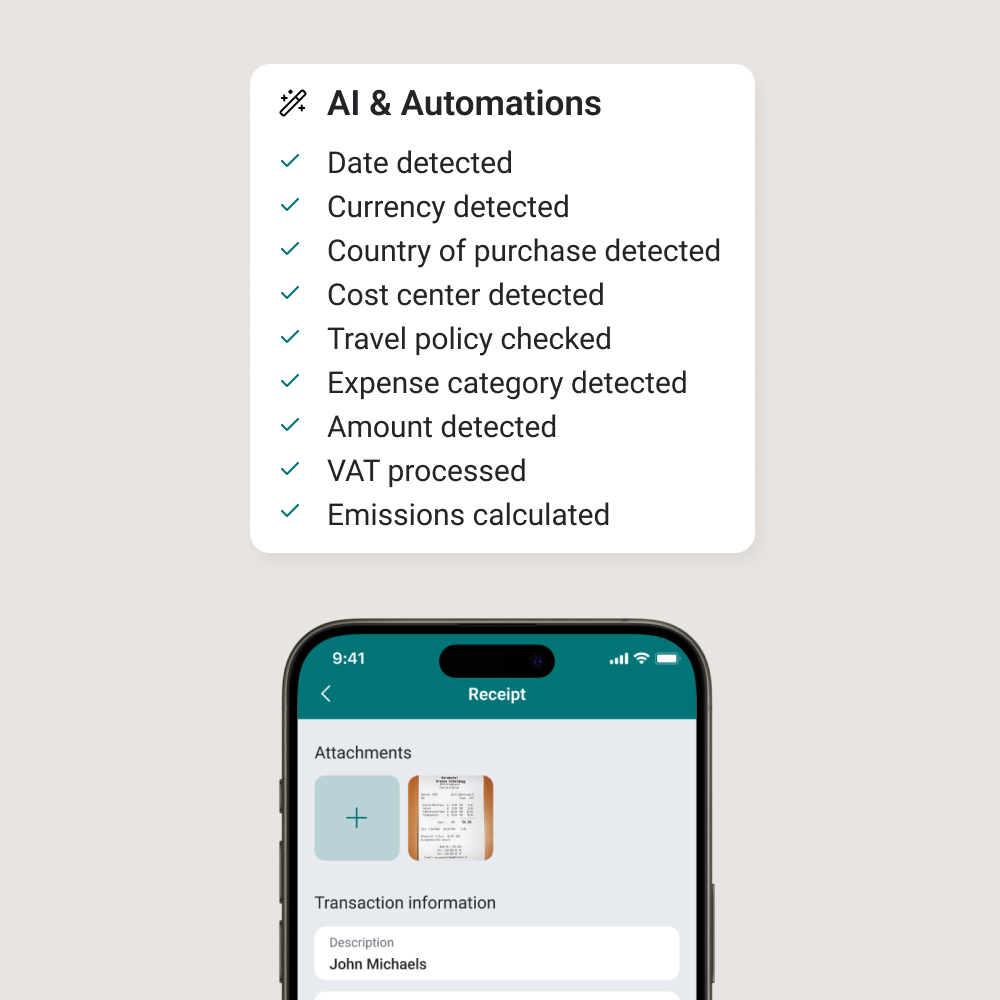
For companies that want to link payments directly to accounting, integrated card solutions tie each transaction to a receipt and cost center from the moment the purchase is made, eliminating the manual reconciliation step entirely.
What’s the difference between a corporate card and a business credit card?
A corporate card is designed for larger organizations with multiple cardholders and typically requires the company, not the individual employee, to be liable for all charges. A business credit card is usually issued to a sole trader or small business owner and often carries personal liability. The key distinction is who bears the financial responsibility and how the card scales across many users.
Corporate cards also tend to come with more sophisticated controls: per-user spending limits, category restrictions, real-time transaction visibility, and integration with enterprise finance systems. Business credit cards are simpler products aimed at smaller operations where one or two people manage all spending.
In practice, the line between the two has blurred. Many card providers now offer business credit cards with multi-user features that were once reserved for corporate programs. When evaluating options, focus less on the label and more on the specific controls, liability structure, and integration capabilities the card actually offers.
What fees should you watch out for when choosing a corporate card?
The fees most likely to affect your total cost are annual or monthly card fees, foreign transaction fees, ATM withdrawal fees, late payment fees, and fees for issuing additional employee cards. Some providers also charge for virtual card creation, currency conversion, or access to detailed reporting tools. Always request a full fee schedule, not just the headline rate.
Foreign transaction fees deserve particular attention for any company with international travel or cross-border purchases. These fees typically range from one to three percent of each transaction and can add up quickly for a team that travels frequently. Cards marketed as internationally focused often waive this fee, but confirm it in writing before committing.
Annual fees can be straightforward or tiered based on the number of cards issued. Some providers charge per active card per month, which is worth comparing against a flat annual fee depending on how many employees will carry a card. If your workforce fluctuates seasonally, a usage-based fee model tends to be more cost-effective than paying a fixed fee for cards that sit unused for months at a time.
How do spending controls and approval workflows work on corporate cards?
Spending controls on corporate cards allow finance teams to set limits at the individual card, department, or category level. Common controls include maximum transaction amounts, merchant category restrictions, geographic limits, and daily or monthly caps. Approval workflows add a layer of oversight by requiring a manager or finance team member to authorize purchases above a defined threshold before or after the transaction occurs.
Pre-approval workflows are more common for large or unusual purchases. The employee submits a request, a designated approver reviews it, and the card is temporarily unlocked or a virtual card is issued for that specific transaction. Post-approval workflows, where the purchase happens first and is reviewed afterward, are more practical for everyday spending and rely on receipt submission and expense categorization to close the loop.
The most effective setups combine both: routine low-value purchases proceed without friction, while high-value or out-of-policy transactions trigger an automatic review. When corporate cards are connected to an expense management platform, these workflows can be configured at a granular level, with automatic reminders sent to employees who have not submitted receipts and escalation rules for overdue approvals.
How does a corporate card integrate with expense management software?
A corporate card integrates with expense management software by automatically importing transaction data into the platform the moment a purchase is made. The software matches each transaction to a submitted receipt, applies the correct cost center or project code, and pushes the reconciled entry to the connected accounting system. This eliminates manual data entry and reduces the time between a purchase and its appearance in the company’s books.
The depth of integration varies. At the basic level, the card provides a transaction feed that employees then match to receipts manually. At the advanced level, the card and expense platform share a single environment: the card issues the payment, the platform captures the receipt via a mobile scan, and the accounting entry is created automatically with no human intervention required.
Bezala Card service is an example of the latter approach, connecting Visa Platinum Business card payments and receipt management on the same platform so that every transaction is immediately visible to the finance team with full context. For companies already using an ERP or accounting system such as NetSuite, Business Central, or Procountor, the integration extends further, pushing reconciled data directly into the ledger without any manual export or import step.
Which corporate card features matter most for international companies?
For international companies, the features that matter most are global card acceptance, multi-currency support, no or low foreign transaction fees, and the ability to configure spending controls and approval workflows by country. A card accepted on a major network such as Visa or Mastercard will work in virtually every market, but the supporting expense management infrastructure needs to handle local tax rules, per diem rates, and currency reporting accurately.
Country-specific compliance is often overlooked during card selection. VAT reclaim rules, mileage reimbursement rates, and per diem allowances differ significantly between markets, and a card program that cannot accommodate those differences creates manual workarounds for the finance team. Look for platforms that allow you to configure settings individually for each country where employees are based or traveling.
Real-time visibility is equally important when employees are spending across time zones. A finance team in Helsinki should be able to see a transaction made in Singapore the moment it happens, not at the end of the month when the statement arrives. Automatic receipt reminders and mobile-first submission tools help close that loop regardless of where in the world an employee is working.
- Global network acceptance: Visa or Mastercard coverage ensures the card works in over 200 countries and tens of millions of merchants
- Multi-currency and low FX fees: Reduces the cost of cross-border purchases and simplifies reconciliation
- Country-level configuration: Allows per diem rates, approval flows, and tax rules to be set separately for each market
- Real-time transaction visibility: Gives the finance team immediate oversight regardless of time zone
- Mobile receipt capture: Lets employees submit receipts instantly from anywhere, reducing the risk of missing documentation
This content was generated with the help of AI and it may contain mistakes