
To reduce your company’s business travel carbon footprint, prioritize eliminating unnecessary trips through virtual collaboration, establish a clear travel policy that favors lower-emission transport options, and measure your emissions so you can set meaningful reduction targets. These three levers, taken together, deliver the most significant and lasting impact. The sections below unpack each of these areas in practical detail, from understanding what drives travel emissions to the tools that help you track and manage them.
What contributes most to a company’s travel carbon footprint?
Flights are by far the largest contributor to a company’s travel carbon footprint, accounting for the majority of transport-related emissions in most corporate travel programs. Long-haul international flights are the most carbon-intensive, but even short domestic flights carry a disproportionately high emissions cost relative to the distance covered. After air travel, ground transport, hotel stays, and rental car use make up the remaining share.
Within air travel, the class of service matters significantly. Business class seats consume roughly two to three times more carbon per passenger than economy class seats on the same flight, because premium cabins take up more physical space and therefore a larger share of the aircraft’s total emissions. For companies with frequent executive travel, this distinction alone can represent a meaningful portion of total corporate travel emissions.
Ground transport contributes less per trip but adds up quickly across a large workforce. Employees driving rental cars or using ride-hailing services for every leg of a journey create a steady accumulation of emissions that rarely appears in high-level travel reports. Hotel accommodation also carries an environmental cost, particularly in properties that have not invested in energy efficiency. Taken together, these secondary sources are worth addressing once flight emissions are under control.
How does virtual collaboration reduce business travel emissions?
Virtual collaboration reduces business travel emissions by replacing trips that do not require physical presence with video calls, digital workshops, and online project management. When a meeting that would have required a return flight can be conducted effectively over video, the associated emissions are eliminated entirely rather than offset or reduced. For many companies, a structured shift toward remote-first communication is the single highest-impact action available.
The key is identifying which types of travel genuinely require in-person attendance. Client relationship meetings, complex negotiations, and team onboarding often benefit from physical presence in ways that are difficult to replicate digitally. Routine project updates, internal reviews, and training sessions, on the other hand, are strong candidates for virtual formats without meaningful loss of effectiveness.
Organizations that have formalized this distinction in their travel policies report not only lower emissions but also reduced travel costs and improved employee well-being. Virtual-first defaults also make it easier to enforce sustainable travel choices, because the question becomes “why do we need to travel?” rather than “how should we travel?”
What’s the difference between carbon offsetting and carbon reduction in travel?
Carbon reduction means taking actions that prevent emissions from occurring in the first place, such as replacing a flight with a train journey or a video call. Carbon offsetting means allowing emissions to occur and then funding projects elsewhere, such as reforestation or renewable energy, to compensate for them. Reduction is inherently more effective because it eliminates the emission at the source rather than attempting to neutralize it after the fact.
Offsetting has a legitimate role in a corporate sustainability strategy, but it should not substitute for genuine reduction efforts. Offset quality varies widely, and the carbon accounting behind many offset projects has been questioned by independent researchers. A company that offsets freely while making no structural changes to its travel program is unlikely to meet credible net-zero commitments or satisfy increasingly rigorous ESG reporting requirements.
The recommended approach is to treat reduction as the primary goal and offsetting as a tool for residual emissions that cannot yet be avoided. This means setting an absolute emissions reduction target for corporate travel, working down toward it year by year, and using high-quality, verified offsets only for the gap that remains. This sequencing keeps the focus on structural change rather than purchased credits.
How can a company travel policy lower emissions?
A company travel policy lowers emissions by setting explicit rules that steer employees toward lower-carbon choices before a trip is booked. The most effective policies combine a hierarchy of transport preferences, thresholds for when travel is approved at all, and defaults that make sustainable options the path of least resistance. Without a policy, individual booking decisions default to convenience and cost rather than environmental impact.
Set a transport hierarchy
A transport hierarchy ranks travel modes from lowest to highest carbon intensity and instructs employees to use the lowest available option that meets the journey’s requirements. In practice, this typically means rail travel is preferred over flights for journeys under a defined distance or duration, economy class is the default for all flights, and private car hire is a last resort rather than a first choice. Making this hierarchy explicit removes ambiguity and gives approvers a clear basis for declining high-emission trip requests.
Introduce approval thresholds and pre-trip justification
Requiring employees to justify travel before booking, rather than reporting on it afterward, creates a natural checkpoint that filters out trips that could be handled virtually. Approval thresholds based on journey distance, cost, or estimated emissions shift the default from automatic approval to active scrutiny. Some organizations also include a carbon budget per employee or team, which makes travel emissions a visible consideration in planning decisions throughout the year.
How do you track and measure corporate travel emissions?
To track and measure corporate travel emissions, collect data on all travel activity, convert it to carbon dioxide equivalent using recognized emission factors, and aggregate the results by trip type, department, or individual. The most common data sources are expense reports, travel booking platforms, and corporate card transactions. Without structured data collection, emissions measurement remains an estimate rather than a managed metric.
The Greenhouse Gas Protocol is the most widely used framework for categorizing and calculating corporate emissions. Business travel falls under Scope 3, Category 6, which covers emissions from employee travel in vehicles not owned or controlled by the company. Using a consistent methodology matters because it makes year-on-year comparisons meaningful and supports third-party verification for ESG reporting.
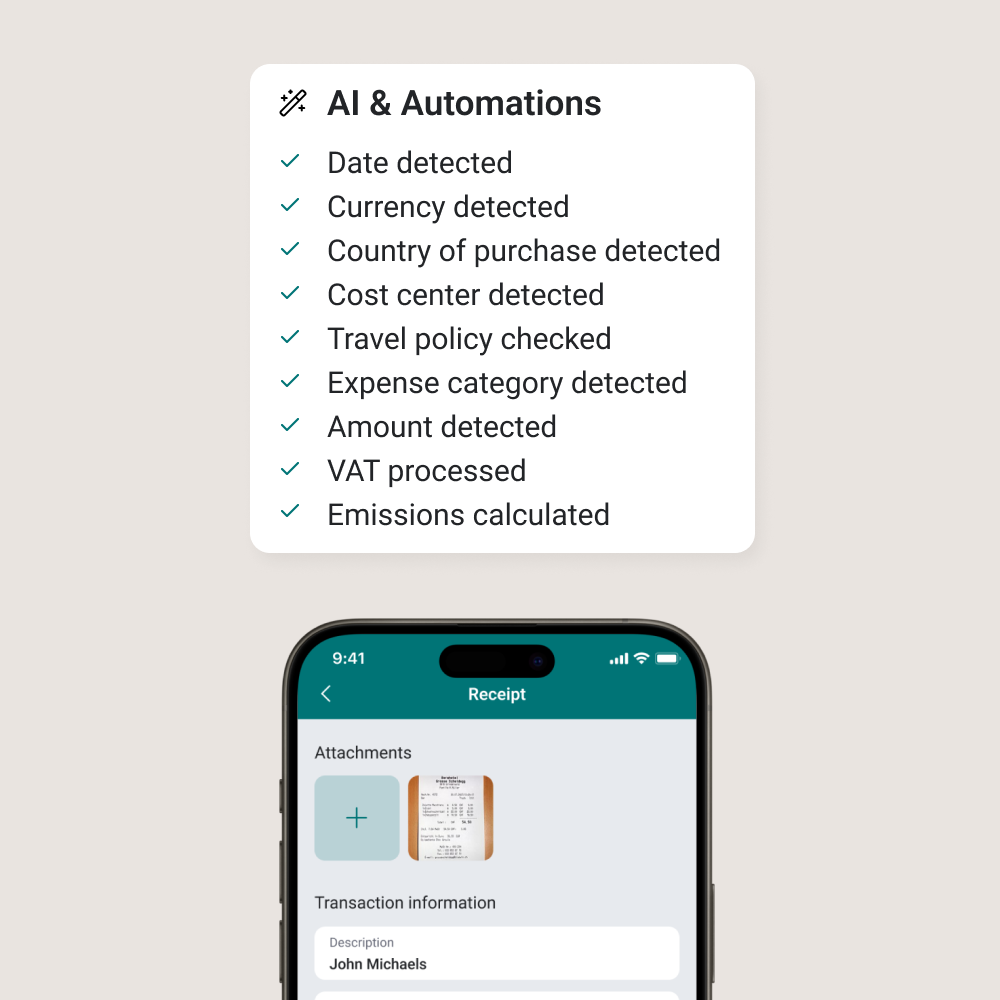
Practically, the accuracy of your emissions data depends directly on the quality of your expense and travel data. Companies that capture detailed trip information, including origin, destination, transport mode, and class of service, can calculate emissions with much greater precision than those relying on aggregate spend data. This is one reason that moving to a structured expense management platform often improves sustainability reporting as a secondary benefit: the underlying data becomes cleaner and more complete.
What are the best tools for managing sustainable business travel?
The best tools for managing sustainable business travel combine travel booking with emissions tracking, expense management with carbon reporting, and policy enforcement with real-time visibility. No single tool does everything, but the most effective setups connect a travel management platform that captures booking data with an expense system that records actual spend and trip details, feeding both into a reporting layer that calculates emissions.
Travel management platforms with built-in sustainability features allow companies to display the carbon cost of each booking option at the point of purchase, making it easier for employees to choose lower-emission alternatives without additional effort. Some platforms also flag when a proposed flight could be replaced by a train journey within a similar time window.
On the expense side, platforms that capture structured trip data, including transport mode, distance, and purpose, enable far more accurate emissions calculations than systems that record only the monetary cost of a journey. Bezala’s expense management platform, for example, captures the detailed mileage and travel data needed to feed accurate Scope 3 calculations, which is increasingly important as ESG disclosure requirements tighten across Europe in 2026.
Reporting tools that consolidate travel emissions data by team, project, or individual give finance and sustainability teams the visibility they need to identify where the largest reductions are possible and to track progress against targets over time. The combination of accurate data capture, policy-aligned booking tools, and consolidated reporting is what separates companies that manage their green business travel systematically from those that rely on one-off initiatives and rough estimates.
This content was generated with the help of AI and it may contain mistakes