

Under CSRD, business travel emissions must be reported as part of Scope 3, Category 6 (business travel) in your company’s sustainability disclosures. This applies to all travel by employees using transport not owned by the company, including flights, trains, rental cars, and taxis. The sections below walk through the specific data requirements, calculation methods, reporting obligations, and common pitfalls for 2026.
Which emission category covers business travel under CSRD?
Business travel emissions fall under Scope 3, Category 6 of the GHG Protocol framework, which CSRD’s European Sustainability Reporting Standards (ESRS) adopt as the basis for corporate greenhouse gas accounting. This category captures all emissions from employee travel for business purposes using transport assets not owned or controlled by the company.
Scope 3 emissions are indirect emissions that occur in a company’s value chain rather than from its own operations. Category 6 specifically covers air travel, rail, road transport (rental cars, taxis, ride-hailing), and accommodation-related emissions when employees travel on behalf of the organization. It does not include employee commuting, which falls under Category 7, or fleet vehicles owned by the company, which fall under Scope 1.
Under ESRS E1, which governs climate-related disclosures, companies are required to disclose material Scope 3 categories. For most service-sector and knowledge-economy businesses, business travel is one of the most significant Scope 3 sources, making Category 6 a high-priority reporting area in 2026.
What data do you need to collect for business travel emissions reporting?
To report CSRD business travel emissions accurately, you need activity data covering the distance traveled, mode of transport, and class of service for each trip taken by employees during the reporting period. The more granular the data, the more accurate the emission calculation will be.
The core data points to collect include:
- Flight data: Origin and destination airports, flight class (economy, business, first), and whether flights are short-haul or long-haul
- Rail travel: Distance or route data, and the energy source of the rail network where available
- Road transport: Distance traveled by rental car or taxi, and vehicle type or fuel type if known
- Accommodation: Number of hotel nights, which can be used to estimate associated energy consumption
- Spend data as a fallback: When activity data is unavailable, spend-based estimates using spend per transport category can serve as a proxy, though this method is less accurate
Data quality matters significantly for CSRD compliance. Auditors and assurance providers will assess whether your methodology is consistent, documented, and reproducible. Relying on spend-based estimates for all travel when activity data is available will likely be flagged as a data quality weakness in third-party assurance reviews.
How do you calculate emissions from different travel types?
Emissions from business travel are calculated by multiplying activity data (typically distance in kilometers) by an emission factor specific to that transport mode and class. The result is expressed in kilograms or tonnes of CO2 equivalent (CO2e), which accounts for all greenhouse gases, not just carbon dioxide.
Air travel calculations
Flights are typically the largest source of business travel emissions. The calculation uses distance between airports multiplied by an emission factor that varies by cabin class. Business class seats carry a higher emission factor than economy because they occupy more physical space on the aircraft, which means a larger share of total flight emissions is attributed to each seat. Most organizations use emission factors from sources such as the UK Government’s DEFRA conversion factors or the ICAO Carbon Emissions Calculator as reference points. A radiative forcing multiplier is often applied to air travel to account for the additional warming effect of contrails and other non-CO2 impacts at altitude.
Road and rail travel calculations
For rental cars and taxis, the emission factor depends on vehicle type and fuel. A petrol car produces significantly more CO2e per kilometer than an electric vehicle, so collecting vehicle type data where possible improves accuracy. Rail emissions vary considerably by country because they depend on the electricity grid mix of the national rail network. Travel by train in a country with a high share of renewable electricity will produce far lower emissions per kilometer than diesel-powered rail in other regions.
Who is required to report business travel emissions under CSRD in 2026?
In 2026, CSRD reporting obligations apply to large EU companies that were required to report under the Non-Financial Reporting Directive (NFRD), meaning public-interest entities with more than 500 employees. These organizations are filing their first CSRD-compliant reports covering the 2025 financial year, with disclosures due in 2026.
The second wave of companies, covering large EU companies that do not meet the NFRD threshold but exceed two of three criteria (250 or more employees, net turnover above EUR 50 million, or total assets above EUR 25 million), will begin reporting on their 2026 financial year, with disclosures due in 2027. Non-EU companies with significant EU revenue will follow in subsequent years.
Even companies not yet directly in scope should pay attention. Large companies under CSRD will increasingly request emissions data from their suppliers and business partners as part of their own Scope 3 reporting. This means smaller organizations may face indirect pressure to track and report business travel carbon emissions well before they are formally required to do so under the directive.
What are the most common mistakes in business travel emissions reporting?
The most common mistakes in CSRD business travel emissions reporting are incomplete data collection, inconsistent emission factor sources, and failing to document methodology clearly enough to withstand third-party assurance. Each of these weaknesses can result in restatements or qualified assurance opinions.
- Relying entirely on spend data: Using only financial spend to estimate emissions is a last resort, not a default. When booking records or expense reports contain route and mode information, that data should be used instead.
- Ignoring cabin class for flights: Reporting all air travel at economy-class emission factors significantly understates emissions if senior staff regularly travel in business or first class.
- Using outdated or inconsistent emission factors: Switching emission factor databases between reporting years without documenting the change makes year-on-year comparisons unreliable and complicates assurance.
- Excluding certain travel types: Companies sometimes report only flights and omit rail, taxi, and rental car travel. ESRS E1 requires a complete and consistent boundary.
- No audit trail from source data to reported figures: Assurance providers need to trace reported totals back to underlying records. If expense data is held across disconnected systems, this traceability becomes very difficult to establish.
How can expense management tools support CSRD travel emissions reporting?
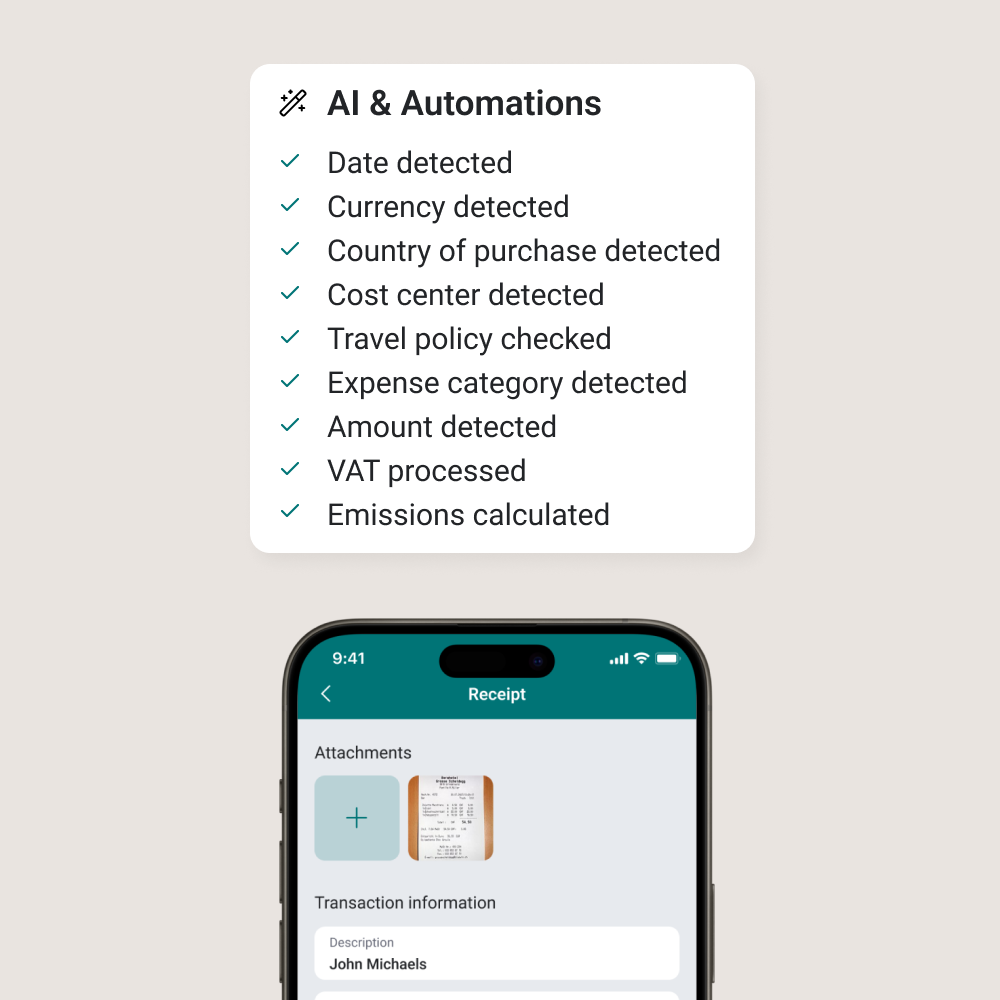
Expense management platforms support CSRD travel emissions reporting by centralizing the activity data that emissions calculations depend on. When employees submit travel expenses digitally, the platform captures route information, transport mode, and cost in a structured, auditable format that can feed directly into emissions calculations.
This matters because the hardest part of Scope 3 Category 6 reporting is not the calculation itself but the data collection. When travel expenses are tracked on paper, in spreadsheets, or across disconnected booking and finance systems, compiling a complete dataset for the reporting period is time-consuming and error-prone. A unified expense platform creates a single, consistent record of all employee travel throughout the year.
Platforms like Bezala capture structured travel data at the point of submission, including mileage, destination, and transport type, which gives finance teams the raw material needed to calculate business travel carbon emissions accurately. The integration of company card transactions with expense reporting also closes gaps where travel spend might otherwise be recorded without the underlying trip detail needed for emissions accounting.
For companies building toward CSRD compliance, the practical recommendation is to treat your expense management system as a primary data source for Scope 3 Category 6 reporting, and to audit whether your current setup captures enough detail to support both financial and emissions reporting from the same underlying records.
This content was generated with the help of AI and it may contain mistakes