
Electric vehicles reduce but do not eliminate Scope 3 travel emissions. Even with zero tailpipe emissions, EVs carry an indirect carbon footprint tied to electricity generation, vehicle manufacturing, and battery production. For corporate sustainability reporting, this distinction matters significantly. The sections below address the most common questions finance and sustainability teams face when accounting for EV travel under Scope 3.
Are electric vehicles truly zero-emission for Scope 3 reporting?
Electric vehicles are not zero-emission for Scope 3 reporting purposes. While EVs produce no direct exhaust, their carbon footprint comes from the electricity used to charge them, which varies by grid source, as well as from vehicle and battery manufacturing. Scope 3 reporting captures these upstream and downstream emissions, so EVs must still be quantified and disclosed.
The widespread assumption that EVs simply do not count in emissions reporting is one of the most consequential misunderstandings in corporate sustainability work. Under frameworks like the GHG Protocol, which underpins most Scope 3 reporting standards, emissions are tracked across a value chain, not just at the point of combustion. An EV charged from a coal-heavy grid can carry a higher per-kilometre carbon footprint than many assume, while one charged from renewable sources may be substantially lower.
For companies with net-zero commitments or Science Based Targets, treating EV travel as automatically clean introduces material inaccuracies into reported figures. Accurate Scope 3 disclosure requires applying an emissions factor to EV travel just as it does for petrol or diesel journeys.
How is the carbon footprint of an EV business trip calculated?
The carbon footprint of an EV business trip is calculated by multiplying the distance travelled by an electricity consumption rate (typically in kWh per kilometre) and then applying the carbon intensity of the electricity grid used for charging. The result is expressed in kilograms of CO2 equivalent (CO2e). The charging location and its grid mix are the primary variables.
In practice, most companies use published emissions factors from national environmental agencies or recognised databases such as the UK Government’s conversion factors or the International Energy Agency’s country-level grid intensity figures. These factors convert electricity consumption into a CO2e value that can be included in Scope 3 calculations.
A typical approach looks like this:
- Record the distance of the business trip in kilometres or miles
- Estimate energy consumption using the vehicle’s average efficiency rating (e.g. 0.20 kWh/km)
- Identify the relevant grid emissions factor for the country or region where charging occurred
- Multiply consumption by the emissions factor to arrive at a CO2e figure
Where employees charge at home, the national average grid intensity is typically used as a reasonable proxy. Where charging occurs at a workplace using certified renewable energy, a lower or near-zero factor may be applicable, provided this is documented and auditable.
How do EV emissions compare to petrol and diesel vehicles under Scope 3?
In most European countries in 2026, electric vehicles produce significantly fewer Scope 3 travel emissions per kilometre than petrol or diesel equivalents, often by a factor of two to four depending on the grid mix. However, the gap narrows considerably in regions with carbon-intensive electricity generation, and EVs do not always win on a life-cycle basis when battery manufacturing is included.
For a straightforward business travel comparison, the relevant metric is well-to-wheel emissions, which accounts for fuel extraction or electricity generation through to vehicle use. Petrol and diesel vehicles carry relatively predictable emissions factors per litre of fuel consumed. EVs introduce more variability because the carbon intensity of electricity differs substantially between countries and even between times of day.
In Nordic countries, where hydro and nuclear power dominate the grid, EV business travel can be close to genuinely low-carbon. In countries with a higher proportion of fossil-fuel generation, the advantage over a modern, efficient diesel vehicle may be more modest. Companies operating across multiple geographies should apply country-specific grid factors rather than a single average, as this produces a more accurate and defensible Scope 3 disclosure.
Which Scope 3 categories cover electric vehicle use?
Electric vehicle use in a business context typically falls under Scope 3 Category 6 (Business Travel) when employees travel in EVs they do not own, such as rental cars or taxis, and under Scope 3 Category 7 (Employee Commuting) when employees drive their own EVs to and from work. If a company provides employees with EVs as company cars, the relevant category shifts depending on whether the vehicle is owned or leased.
Category 6 is the most commonly referenced in the context of business travel carbon footprints, covering all travel by employees for work purposes in vehicles the company does not own. This includes EV rental cars, electric taxis, and employee-owned EVs used for business trips where the company reimburses mileage.
Category 7 covers the daily commute in employee-owned EVs. While commuting emissions are sometimes deprioritised in corporate reporting, they are a required disclosure under a full Scope 3 inventory and can be material for large organisations with distributed workforces.
For companies that own or lease EV fleets, the electricity consumed by those vehicles typically falls under Scope 2 if the company controls the charging infrastructure, or remains in Scope 3 if employees charge independently and are reimbursed. The boundary between Scope 2 and Scope 3 here depends on operational control, which should be defined clearly in the company’s reporting methodology.
Does charging source affect how EV travel is reported in Scope 3?
Yes, the source of electricity used to charge an EV directly affects the emissions factor applied in Scope 3 reporting. Charging from a grid powered predominantly by renewables produces a lower CO2e figure than charging from a fossil-fuel-heavy grid. Where a company can demonstrate that charging occurred using certified renewable electricity, it may apply a lower emissions factor, provided the evidence is auditable.
This is an area where reporting standards are still evolving. The GHG Protocol allows companies to use market-based or location-based methods for electricity emissions, a distinction that carries over into Scope 3 EV calculations. Under a location-based approach, the average grid intensity of the country or region applies. Under a market-based approach, the company can account for renewable energy certificates or power purchase agreements that cover the electricity used.
In practical terms, most companies default to location-based grid factors for employee EV charging because tracking the actual charging source for each trip is operationally complex. However, as reporting requirements tighten under frameworks like the EU’s Corporate Sustainability Reporting Directive, more granular evidence of charging source may become expected rather than optional.
How should companies track and report EV travel data for Scope 3 compliance?
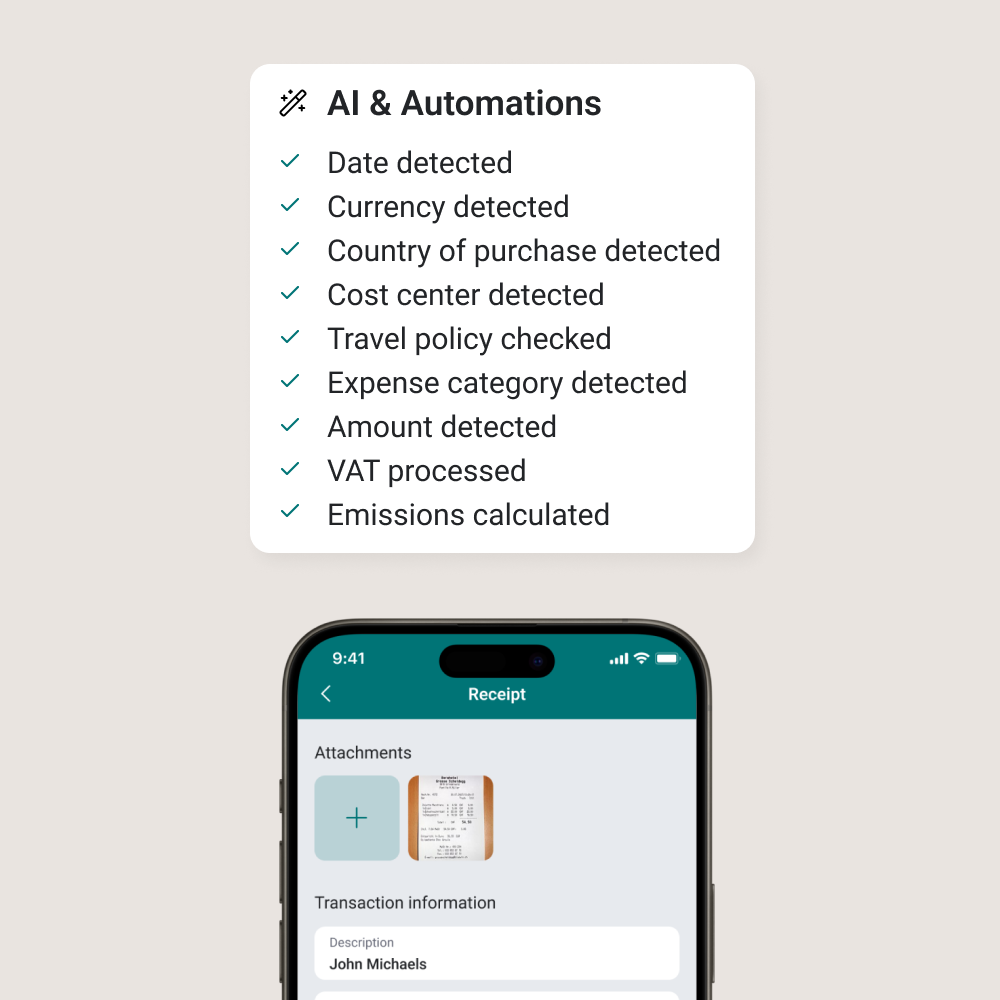
Companies should track EV travel data by capturing trip distance, vehicle type, and charging location for each business journey, then applying the appropriate grid emissions factor to calculate CO2e. The most reliable approach integrates this data collection into existing expense and travel management workflows so that EV trips are logged consistently alongside other transport modes.
The core challenge is that EV travel data is often fragmented. Employees may charge at home, at public stations, or at the office, each with different emissions implications. Without a structured process for capturing this information, finance and sustainability teams are left making broad assumptions that reduce the accuracy and credibility of Scope 3 disclosures.
Effective tracking typically involves the following steps:
- Requiring employees to log business trips with distance, vehicle type, and charging location at the point of expense submission
- Applying country-specific or region-specific grid emissions factors sourced from recognised databases
- Distinguishing between company-owned EVs, employee-owned EVs used for business, and rental EVs for accurate category assignment
- Storing supporting documentation to satisfy audit requirements under CSRD and similar frameworks
- Reviewing emissions factors annually, as grid intensity changes as renewable capacity expands
Platforms that handle mileage reimbursement can play a useful role here, as they already capture the trip data needed for emissions calculations. When mileage data flows directly from employee submissions into financial and sustainability reporting, the risk of gaps or manual errors in Scope 3 disclosures is substantially reduced. For companies managing travel across multiple countries, ensuring that the correct national emissions factor is applied automatically to each trip is a meaningful step toward accurate and audit-ready corporate travel sustainability reporting.
This content was generated with the help of AI and it may contain mistakes