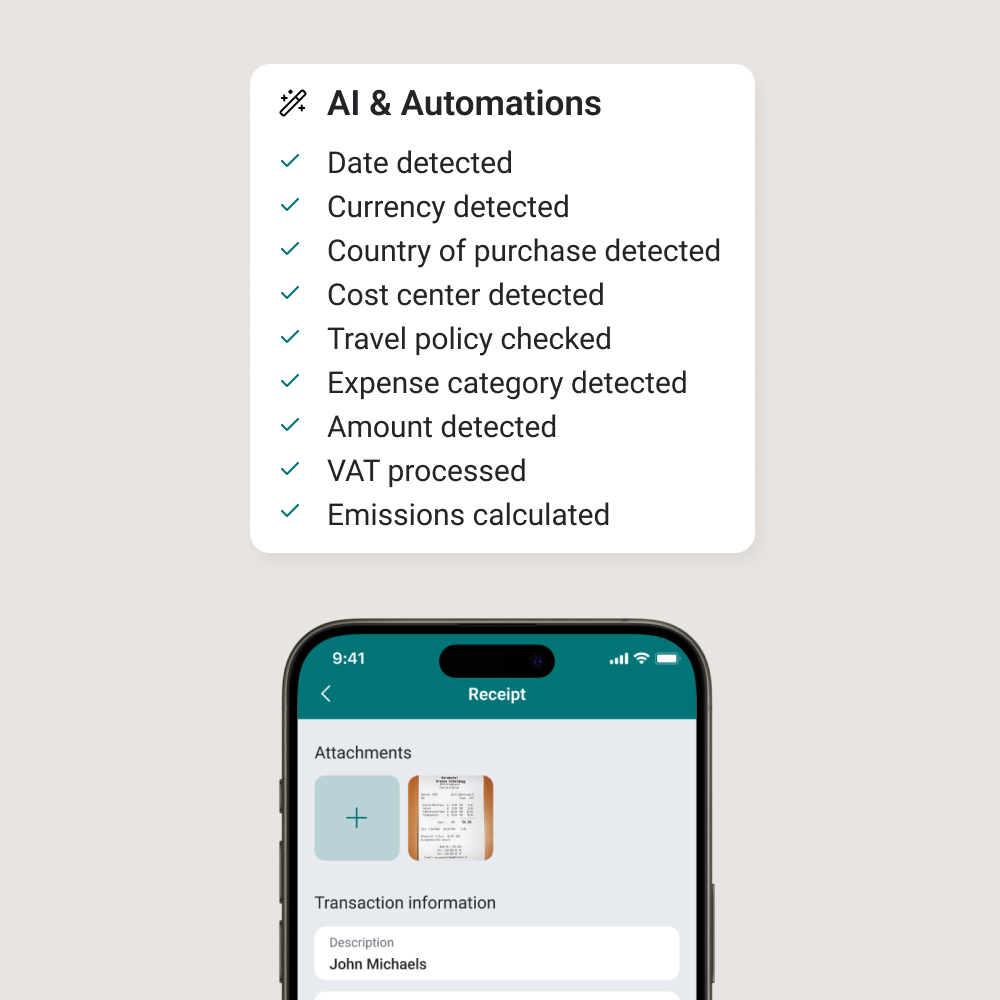


Mileage reimbursement data helps with ESG reporting by providing a direct, quantifiable record of employee-driven business travel, which is one of the most significant sources of carbon emissions that companies must disclose under modern sustainability frameworks. Because every reimbursed trip captures distance, vehicle type, and purpose, this data can be converted into emission estimates that feed directly into your carbon accounting. The sections below unpack how that conversion works, which frameworks demand it, and how finance teams can make the process far less painful.
What does mileage reimbursement data actually capture about emissions?
Mileage reimbursement data captures the distance, date, purpose, and often the vehicle type associated with each employee-driven business trip. When aggregated across a workforce, these records create a detailed picture of fuel consumption and associated carbon output that would otherwise be invisible to finance and sustainability teams.
Each reimbursement claim contains more useful information than it might appear. The distance traveled can be multiplied by an emission factor specific to the vehicle category to produce a carbon dioxide equivalent figure. Petrol and diesel cars carry different emission factors, and electric vehicles carry a different calculation again, based on the grid’s energy mix. If your reimbursement system also captures whether a journey was by private car, company car, or motorcycle, the resulting emission estimates become significantly more accurate.
Beyond individual trips, the aggregated dataset reveals patterns: which departments generate the most travel, which routes are most frequent, and whether travel volumes are trending up or down year over year. This trend data is as valuable for ESG purposes as the raw emission totals, because sustainability frameworks increasingly require companies to demonstrate progress over time, not just disclose a single year’s figure.
How does mileage data feed into Scope 3 emissions calculations?
Employee business travel in privately owned vehicles falls under Scope 3, Category 6 of the Greenhouse Gas Protocol, which covers indirect emissions that occur in a company’s value chain but are not directly controlled by the company. Mileage reimbursement records are the primary data source for calculating these emissions because they represent the only systematic record of how far employees actually drove for work.
The calculation process follows a straightforward structure. Total kilometers or miles reimbursed are multiplied by an emission factor expressed in kilograms of CO2 equivalent per unit of distance. National environmental agencies and bodies such as the UK’s Department for Energy Security and Net Zero publish regularly updated emission factors by vehicle type and fuel category. Using the most current published factors rather than industry averages improves both accuracy and auditability.
One important distinction is that mileage reimbursement data covers employee-owned vehicles used for business purposes. Travel in company-owned vehicles is typically captured under Scope 1 rather than Scope 3, because the company controls those assets directly. Finance teams need to be clear about which category each journey falls into, particularly when employees have the option to use either a company card for fuel or a personal vehicle reimbursement claim.
Which ESG frameworks require employee travel and mileage data?
Several major ESG and sustainability reporting frameworks require or strongly recommend disclosure of employee business travel emissions, making mileage reimbursement records an essential input. The most widely adopted frameworks that touch this data are the GHG Protocol, the Global Reporting Initiative, the Carbon Disclosure Project, and the European Sustainability Reporting Standards.
- GHG Protocol: The foundational standard for corporate carbon accounting. Its Scope 3 guidance specifically lists business travel as a category requiring quantification, and employee-owned vehicle travel is a defined sub-category.
- GRI Standards (GRI 305): Requires disclosure of Scope 3 emissions where material, with business travel commonly identified as a material category for organizations with field-based or frequently traveling workforces.
- CDP Climate Change questionnaire: Asks companies to report Scope 3 emissions by category, including business travel, and to describe the methodologies and data sources used.
- European Sustainability Reporting Standards (ESRS): Introduced under the EU’s Corporate Sustainability Reporting Directive, ESRS E1 requires detailed climate-related disclosures including Scope 3 emissions, affecting a large number of European companies from 2026 onward.
For companies operating across multiple countries, the compliance picture becomes more complex. Some jurisdictions have additional national reporting requirements layered on top of these international frameworks, and the definitions of which travel categories must be included can vary. Organizations with operations across Europe in particular should ensure their mileage data is structured in a way that satisfies both the ESRS requirements and any local regulatory obligations.
What are the common data quality problems with mileage records for ESG purposes?
The most common data quality problems with mileage records for ESG reporting are missing vehicle type information, inconsistent distance verification, gaps in coverage caused by informal reimbursement practices, and a lack of standardization across different country operations. Each of these problems introduces uncertainty that undermines the credibility of the resulting emission calculations.
Missing or inconsistent vehicle data
When employees submit mileage claims without specifying whether they drove a petrol, diesel, hybrid, or electric vehicle, the finance team must either use a generic average emission factor or go back and collect that information retrospectively. Generic factors reduce accuracy, while retrospective collection is time-consuming and often incomplete. A well-designed expense system captures vehicle type at the point of claim submission, eliminating this problem at source.
Informal or paper-based processes
In organizations that still rely on spreadsheets, paper forms, or email-based reimbursement requests, a meaningful proportion of business travel never gets formally recorded. Employees may choose not to claim small amounts, or claims may be submitted and processed outside the main system. These gaps mean the recorded mileage total understates actual business travel, producing an artificially low emission figure that may not survive external audit scrutiny.
A related problem is the lack of route verification. Reimbursement systems that rely entirely on employee-entered distances without any map-based validation create opportunities for both honest errors and deliberate inflation. For ESG purposes, auditors expect to see evidence that distance records are reasonable and verifiable, not simply self-reported.
How can finance teams use expense management tools to automate ESG mileage reporting?
Finance teams can automate ESG mileage reporting by using an expense management platform that captures structured, verifiable mileage data at the point of submission and makes it available for export or direct integration with carbon accounting tools. The key is eliminating manual data collection steps and ensuring that every claim contains the fields needed for emission calculations.
An integrated map feature within the expense tool addresses the distance verification problem directly. When employees log a journey using a built-in map rather than typing a distance manually, the system records a route-verified distance that is both more accurate and more defensible during an audit. Platforms like Bezala include this kind of mileage reimbursement functionality, which captures structured trip data that finance teams can aggregate for reporting purposes.
Beyond data capture, the reporting workflow matters. Finance teams need to be able to filter mileage data by date range, employee, department, country, and vehicle type, then export it in a format that can be fed into a carbon calculation model. The less manual work required to transform raw reimbursement records into ESG-ready data, the more reliable and repeatable the reporting process becomes.
For international organizations, a platform that applies country-specific rules to each reimbursement also simplifies the consolidation step. When all subsidiary data is structured consistently and held in one system, producing a group-level Scope 3 travel figure becomes a reporting task rather than a data archaeology project. As ESG disclosure requirements tighten across Europe in 2026, that operational readiness is increasingly the difference between organizations that report with confidence and those that scramble to reconstruct records after the fact.
This content was generated with the help of AI and it may contain mistakes