

Most companies have some version of a travel expense approval process. The problem is that “some version” often means a patchwork of email threads, spreadsheet trackers, and verbal sign-offs that create more friction than control. Finance teams spend hours chasing receipts. Managers approve reports they barely read. Employees wait weeks for reimbursements they needed yesterday. The process exists, but it does not really work.
Building an expense approval workflow that holds up under real operational pressure requires more than good intentions. It requires clear policy, logical structure, the right tools, and a way to measure whether any of it is actually functioning. This guide walks through each of those layers in turn.
Where most travel expense workflows break down
The failure points in most expense workflows are predictable, and they tend to cluster around the same structural weaknesses. Understanding them is the first step toward designing something better.
The most fundamental problem is that many organizations rely on email and spreadsheets as their primary approval infrastructure. Email is a communication tool, not a control system. It provides no enforced policy, no live budget check, and no permanent record linking an approver to a specific decision at a specific time. Reports sit in inboxes, get buried under other messages, and move forward only when someone remembers to follow up. The result is approval bottlenecks that slow reimbursements and leave finance teams missing data at exactly the moment they need it most for month-end close.
Late and batched submissions compound the problem. When employees collect all their expenses and submit once a month, a wave of reports with missing receipts, unclear descriptions, and data entry errors arrives simultaneously at the worst possible time. Nearly a quarter of expense claims are approved after 30 or more days, according to industry research, and that delay ripples outward into cash flow visibility, forecasting accuracy, and employee satisfaction.
Policy awareness and policy compliance are not the same thing. Research consistently shows that a large share of business travelers are broadly aware that a travel policy exists but are unfamiliar with its specific rules. When employees encounter policy details only after submitting a claim, violations are caught after money has already been spent. A 1% out-of-policy rate on a meaningful annual travel budget translates into real financial leakage distributed across hundreds of small transactions that no single line item captures.
A newer and rapidly escalating risk deserves attention: AI-generated fake receipts. A 2026 survey found that 40% of U.S.-based employees admitted to using AI to generate or alter a receipt for a business expense. The same research found that financial pressure from slow reimbursements was a key driver, with many employees incurring overdraft fees or credit card interest while waiting to be paid back. Slow processes do not just frustrate employees. They create conditions that incentivize fraud.
Key components of a solid approval policy
A well-designed expense approval policy is the foundation everything else is built on. Without it, even the most sophisticated workflow software has nothing meaningful to enforce.
The policy needs to be specific enough that neither employees nor approvers have to make judgment calls. Vague directives like “book reasonably priced hotels” cannot be interpreted by automated systems and invite inconsistency when interpreted by humans. Every category that generates expenses should have explicit spending thresholds, defined documentation requirements, and clear rules about what qualifies for reimbursement and what does not.
What the policy should cover
A complete travel expense policy addresses several distinct areas. Eligible expense categories and their limits form the core. Documentation requirements define what proof is needed and at what level of detail. An itemized hotel folio, for example, tells a different story than a lump-sum credit card statement. For group meals, the policy should require a list of attendees and a written business purpose.
The policy should also define reimbursement methods. Organizations typically choose between per diem allowances, actual expense reimbursement with caps, or a hybrid of the two. Each approach involves trade-offs between administrative simplicity and accuracy, and the right choice depends on the nature of the travel and the maturity of the finance function.
Non-reimbursable items deserve their own explicit list. Naming specific exclusions, such as personal entertainment, fines, or companion travel, eliminates ambiguity and reduces the volume of exception requests that finance teams have to handle. The policy should also state clearly that no individual may approve their own expenses, and that informal authorizations through messaging apps or verbal agreements carry no standing. Consequences for non-compliance should be stated plainly, because transparency about enforcement encourages adherence more effectively than vague warnings.
Policy before platform
One principle that organizations frequently get backwards: policy design must drive system configuration, not the reverse. Allowing software defaults to define approval workflows inverts the correct sequence. The policy pillars, spending thresholds, eligible categories, and approval routing logic should all be documented before a single rule is configured in any platform.
How to map approval tiers to your org structure
A single approval threshold applied uniformly across all expense types creates two problems at once: it bottlenecks routine, low-value submissions and provides insufficient oversight for high-cost or high-risk ones. Tiered approval routing solves both by matching the level of scrutiny to the level of risk.
The structure most organizations settle on involves two to four approval levels. Fewer than two creates oversight gaps. More than four becomes difficult to maintain and introduces delays that undermine the process. A practical starting point: low-value, clearly compliant expenses route to direct manager approval only. Higher-value submissions require a second approval from finance or a senior leader. Any expense that falls outside policy triggers a separate path requiring written justification and review by a designated exception approver.
Building tiers from actual spend data
Approval thresholds should be derived from actual spending patterns, not copied from a generic template. A threshold set too low means finance controllers spend time reviewing routine purchases. A threshold set too high means significant expenditures clear with minimal scrutiny. Twelve months of historical spend data will reveal where the natural breakpoints are, and those breakpoints should anchor the tier design.
Pre-trip approval is a particularly effective control lever. Requiring approval before travel is booked, rather than after it is completed, shifts the conversation from reimbursement to authorization. Organizations that build pre-trip approval into their workflows tend to see meaningfully lower out-of-policy spend, because the approval decision happens before the money is committed rather than after.
Handling exceptions and executive travel
Executive travel exceptions are inevitable, whether driven by schedule constraints, client commitments, or security requirements. The risk is not the exception itself but the undocumented exception, which erodes policy credibility across the organization. A fast-track bypass for urgent travel situations can be built into the workflow as long as it carries a full audit trail. Similarly, executives may receive higher-touch support without that translating into unlimited spending authority. Service tier and policy tier should remain separate.
Exception patterns should also be tracked over time. When the same policy provision is regularly bypassed for the same reason, that is a signal worth investigating. It may indicate a policy gap that needs revision, or a negotiating opportunity with a preferred supplier.
Automating the process without losing control
Automation does not replace judgment in expense management. It removes the repetitive, error-prone manual steps that consume finance team capacity and slow the entire process down, freeing human reviewers to focus on decisions that actually require their attention.
The operational case for automation is straightforward. Manual expense report processing costs significantly more per report and takes considerably more staff time than automated processing. When receipts are captured digitally at the point of purchase and data is extracted automatically using optical character recognition, the manual data entry burden disappears. When approval routing is rule-based and configured in the system, reports reach the right approver without anyone having to look up who that is.
Where automation adds the most value
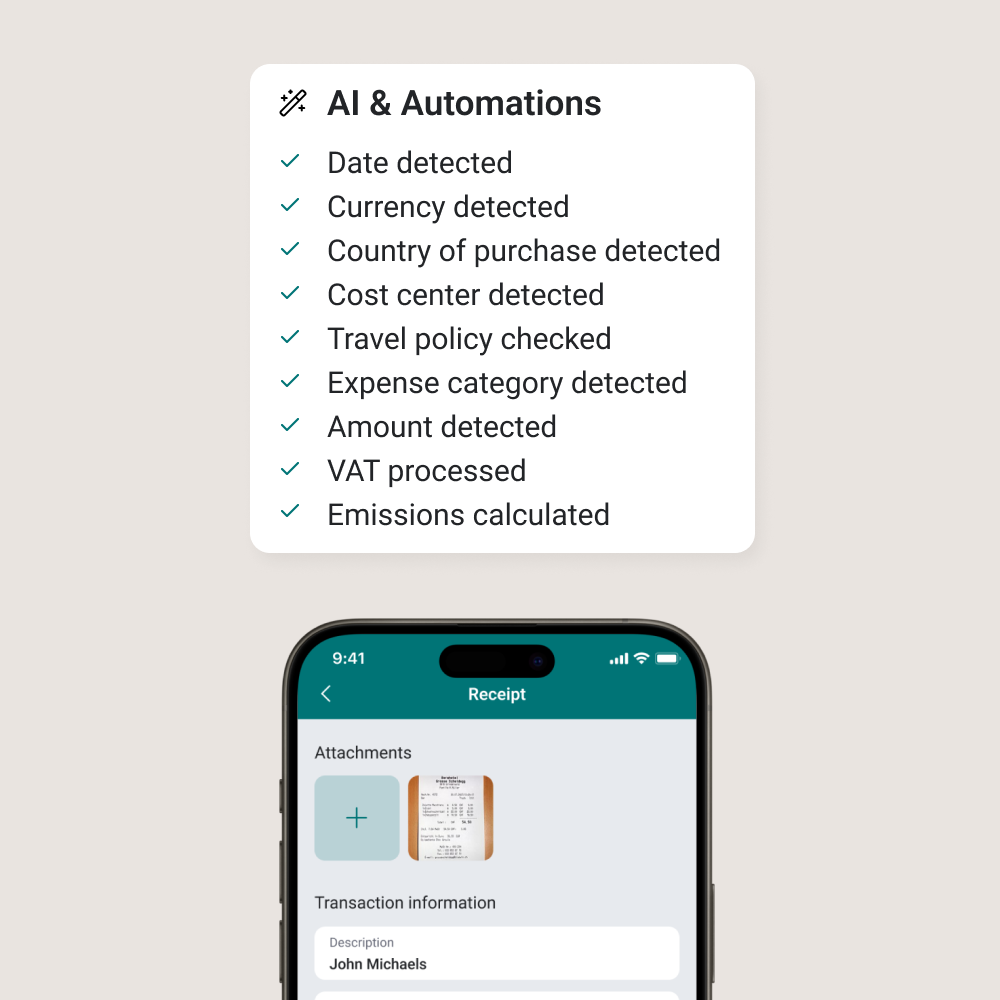
The highest-impact automation capabilities in a modern expense approval workflow include receipt capture and data extraction, policy compliance checking at the point of submission, automated approval routing based on amount and category, and direct integration with accounting or ERP systems so that approved expenses flow into the general ledger without manual input. AI in expense management can also flag anomalies, duplicate submissions, and out-of-policy items in real time rather than catching them during a periodic manual review.
This shift from reactive to proactive control matters. In a manual workflow, policy violations are typically identified after reimbursement has already been processed. Automated systems can surface a potential violation at the moment of submission, or even at the moment of purchase when company cards are involved, giving finance teams the ability to intervene before money leaves the organization.
Keeping humans in the loop
Automation works best when it handles the predictable and escalates the exceptional. Every automated action should have a clear, human-readable rationale and a complete audit trail. Approval thresholds, segregation of duties, and escalation paths should all be explicitly configured rather than left to system defaults. The goal is a workflow where human approvers retain meaningful oversight over high-risk decisions while the system handles the volume of routine, compliant submissions efficiently.
Platforms like Bezala are designed with this balance in mind, combining automated receipt scanning, per diem calculation, and approval routing with full audit trail capture and direct ERP integration, so finance teams gain control without adding administrative overhead.
Common mistakes that slow down reimbursements
Even well-designed expense approval policies break down at the execution level. The most common failure points are operational rather than structural, and most of them are preventable.
Missing receipts are the most frequent cause of delayed or rejected claims. Without documentation, finance cannot verify the amount, the business purpose, or the tax treatment of an expense. Receipts captured on a mobile device at the point of purchase, rather than collected and submitted weeks later, eliminate most of this problem before it starts.
Submission timing and deadline clarity
Without clear submission deadlines, expenses get batched and submitted whenever employees find time. That typically means the last few days of the month, when finance teams are already managing close. A specific rule, such as submitting expenses within a defined number of days of incurring them and by a fixed point in the month-end cycle, removes ambiguity and distributes the workload more evenly. Automated reminders sent directly to employees help enforce these deadlines without requiring manual follow-up from finance.
Incorrect expense categories and missing business purpose descriptions are another common source of delays. They force finance to send claims back for correction, restarting the approval cycle entirely. Most of these errors are not intentional. Employees often do not know the rules well enough to apply them correctly. Clear, accessible policy communication and in-platform guidance at the point of submission address this more effectively than after-the-fact enforcement.
The gap between approval and payment
A frequently overlooked bottleneck sits between the moment an expense is approved and the moment the employee is actually paid. When approval workflows and payment systems operate separately, the handoff between them becomes a manual step, and that is where reimbursements stall. A connected workflow, where approval triggers the downstream payment step automatically, closes this gap. Employees who pay out of pocket for flights, accommodation, or client meals on personal cards feel the reimbursement timeline directly, and slow reimbursement cycles affect how they perceive the organization’s operational competence.
Metrics that reveal if your process is working
A travel expense management process that cannot be measured cannot be improved. The right metrics give finance leaders visibility into whether the workflow is performing as designed, where bottlenecks are forming, and whether policy changes are having the intended effect.
Expense report metrics fall into three categories: efficiency metrics that measure operational speed, compliance metrics that track adherence to policy, and financial impact metrics that connect expense behavior to budget outcomes. Tracking across all three provides a complete picture rather than optimizing one dimension at the expense of another.
The metrics worth tracking consistently
Cost per expense report processed is a direct measure of operational efficiency. A high cost signals manual inefficiency or overly complex approval flows. Reimbursement cycle time, measured from submission to payment, reflects both approval speed and payment process integration. Organizations with efficient processes typically achieve reimbursement within five to seven business days. Longer cycles almost always point to manual bottlenecks, unclear responsibilities, or a disconnect between the approval and payment systems.
Policy violation rate measures the share of expense reports that require intervention for non-compliance. Tracking this monthly reveals whether recent workflow or policy changes are moving the needle. On-time submission rate shows whether employees are meeting defined deadlines, and a persistently low rate often signals a usability problem with the submission process rather than a compliance problem with employees. Pre-trip approval rate is a leading indicator: a high rate means spending commitments are authorized before they are made, which is a fundamentally stronger control position than reviewing expenses after the fact.
Using metrics to drive improvement
Metrics are most useful when they are linked to a responsible decision-maker and reviewed on a consistent cadence. A T&E KPI dashboard that connects cost, compliance, and speed into a single view shifts the finance function from retrospective checking to active process management. When a metric moves outside an expected range, the system should surface it proactively rather than waiting for the quarterly review.
Auditing every expense report is not an efficient use of finance team capacity, and it creates a false sense of security. A risk-based approach, focusing intensive review on high-value, high-risk, or anomalous submissions, is more effective. Automated flagging handles the volume; human judgment handles the exceptions. That division of labor is what a well-functioning expense approval process looks like in practice, and the metrics are what tell you whether it is actually delivering.
This content was generated with the help of AI and it may contain mistakes