
Yes, companies should set science-based targets for travel emissions, particularly if business travel represents a meaningful share of their carbon footprint. Science-based targets (SBTs) provide a credible, externally validated framework that aligns corporate emissions reductions with what climate science says is necessary to limit global warming. For companies with frequent flyers, international operations, or large sales teams on the road, travel emissions are too significant to leave unaddressed in any serious net-zero strategy.
The following sections answer the most common questions companies face when evaluating whether and how to set science-based targets for travel emissions, from what counts as a travel emission to whether offsets can fill the gap.
What counts as travel emissions under science-based targets?
Travel emissions under science-based targets are classified as Scope 3 emissions, specifically under Category 6 (business travel) and Category 7 (employee commuting). These include flights, rail journeys, rental cars, taxis, and hotel stays taken for business purposes. Emissions from company-owned vehicles fall under Scope 1, while leased vehicles may fall under Scope 3 Category 4.
Business travel emissions are calculated based on distance traveled, mode of transport, and emissions factors for each transport type. Flights typically carry the highest emissions intensity per kilometer, especially on long-haul international routes. The Science Based Targets initiative (SBTi) requires companies to account for all material Scope 3 categories, and for most service-sector businesses, Category 6 business travel is among the top contributors to their total carbon footprint.
Some companies also include a radiative forcing uplift factor when calculating aviation emissions. This accounts for the non-CO2 warming effects of aircraft at altitude, such as contrail formation, which can significantly increase the effective climate impact of air travel beyond the CO2 alone.
How do science-based targets for travel emissions actually work?
Science-based targets for travel emissions work by setting a quantified reduction goal aligned with a specific global warming pathway, typically 1.5°C or well below 2°C. Companies commit to reducing their travel-related Scope 3 emissions by a defined percentage over a defined timeframe, validated by the SBTi against recognized methodologies.
The SBTi does not prescribe exactly how companies reduce emissions, only that the pace and scale of reduction must match the required carbon budget. For Scope 3 categories like business travel, the SBTi currently requires companies to set targets covering at least two-thirds of total Scope 3 emissions, and any category that represents more than 40% of total Scope 3 must be included.
In practice, a company might commit to reducing absolute business travel emissions by 50% by 2035 against a 2022 baseline. This target is then submitted to the SBTi for validation, and once approved, the company publicly discloses it and reports progress annually. The target becomes a credible, third-party-endorsed commitment rather than a self-declared pledge.
Which companies are required to set science-based targets?
No company is currently legally required to set science-based targets for travel emissions or any other emissions category. SBTi commitments are voluntary. However, regulatory pressure is increasing, and for many companies, setting science-based targets is effectively becoming a business requirement driven by customers, investors, and supply chain partners.
In the European Union, the Corporate Sustainability Reporting Directive (CSRD) requires large companies and listed SMEs to disclose Scope 3 emissions, including business travel, under the European Sustainability Reporting Standards. While CSRD mandates disclosure, not reduction targets, companies that disclose without credible reduction plans face growing scrutiny from investors and institutional stakeholders.
Companies operating in sectors with high travel intensity, such as consulting, financial services, technology, and professional services, face the strongest pressure to set formal targets. Clients increasingly require Scope 3 data from suppliers as part of their own SBTi commitments, which creates a cascading effect down supply chains. By 2026, many procurement processes in large enterprises explicitly ask whether suppliers have validated science-based targets.
What are the main challenges of setting travel emission targets?
The main challenges of setting science-based targets for travel emissions are data quality, attribution complexity, and the difficulty of reducing emissions without restricting business activity. Unlike Scope 1 and 2 emissions, which companies control directly, Scope 3 business travel depends on employee behavior and third-party transport providers.
Data collection and accuracy
Gathering reliable travel emissions data is harder than it sounds. Expense data, booking platform records, and corporate card statements often exist in separate systems, making it difficult to build a complete picture of travel activity. Without accurate mileage, flight class, and route data, emissions calculations rely on rough averages that undermine target credibility.
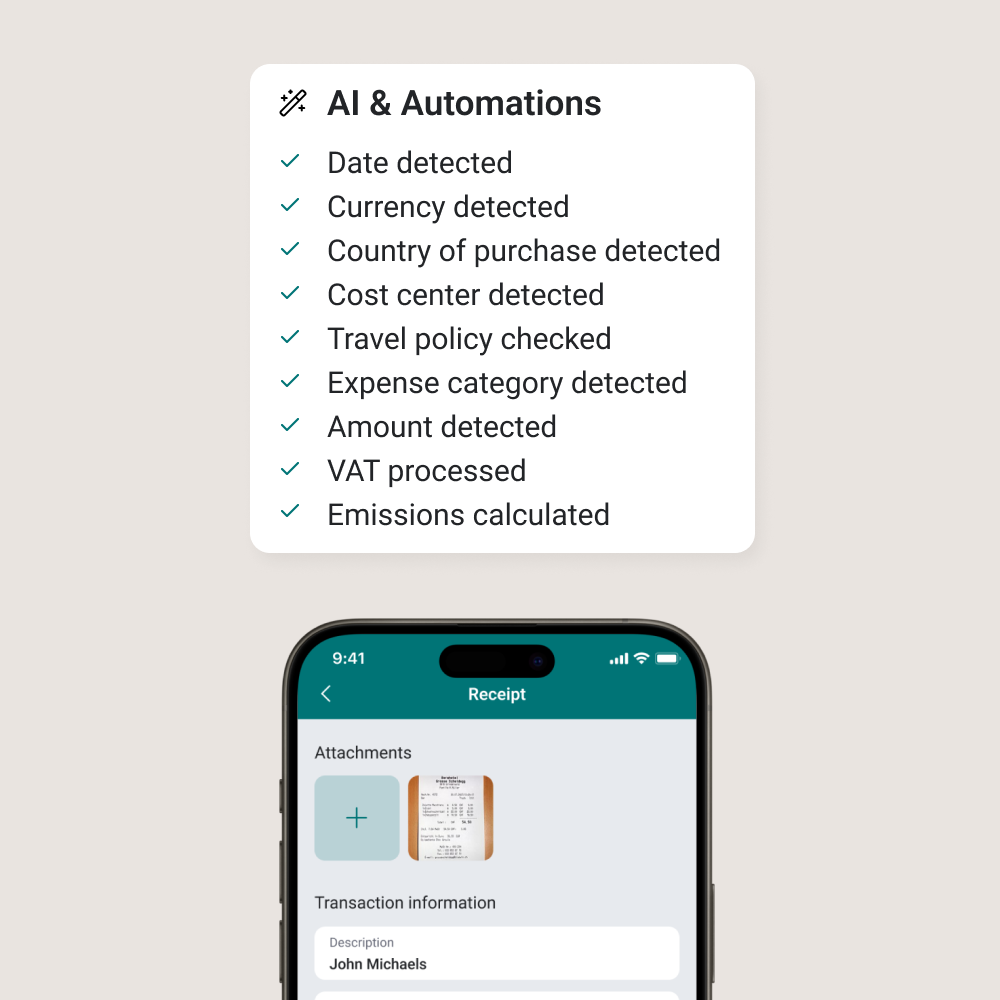
Expense management platforms can help bridge this gap by centralizing travel spend data. When mileage reimbursements, flight bookings, and accommodation costs are captured in one system, finance teams gain the structured data needed to calculate emissions accurately and track reductions over time.
Balancing growth and reduction
Many companies face a structural tension between business growth and absolute emissions reduction. A company expanding into new markets will likely see travel volumes increase even if emissions intensity per trip falls. Absolute reduction targets, which the SBTi generally prefers, can be difficult to meet during periods of rapid growth. Intensity-based targets, measured as emissions per unit of revenue or headcount, offer more flexibility but are viewed as less ambitious by some stakeholders.
How do companies reduce business travel emissions to meet targets?
Companies reduce business travel emissions primarily by shifting to lower-carbon transport modes, reducing unnecessary trips through virtual meetings, and establishing internal travel policies that embed emissions criteria into booking decisions. The most effective strategies combine behavioral change with structural policy reform.
- Replace short-haul flights with rail: Rail travel produces a fraction of the emissions of equivalent flights. Mandating rail for journeys under a set distance threshold, typically three to four hours, can significantly cut aviation-related emissions.
- Introduce internal carbon pricing: Charging business units a shadow price for each ton of CO2 emitted through travel creates a financial incentive to reduce trips and choose lower-carbon options.
- Set flight budgets per employee or team: Allocating a fixed number of flight hours or a carbon budget per year forces prioritization and reduces discretionary travel.
- Expand virtual meeting infrastructure: Investing in high-quality video conferencing reduces the perceived need for in-person visits, particularly for internal meetings and routine client check-ins.
- Require economy class for short routes: Business-class flights produce significantly higher per-passenger emissions due to greater seat space and weight. Restricting premium-cabin travel on shorter routes reduces emissions without eliminating the trip.
- Track and report at the individual level: When employees can see their own travel carbon footprint, behavior tends to shift. Visibility creates accountability.
Policy changes work best when they are embedded in the expense approval process. If travel requests require emissions data at the point of booking, and if approvers are asked to consider lower-carbon alternatives, reductions happen as a natural part of the workflow rather than as an afterthought.
Should companies use carbon offsets to meet travel emission targets?
Carbon offsets should not be used to meet science-based targets for travel emissions. The SBTi explicitly prohibits the use of offsets to achieve near-term emissions reduction targets. Offsets may be used beyond the target boundary or as part of a net-zero claim after deep reductions have already been achieved, but they cannot substitute for actual emissions cuts within the target period.
This is a critical distinction. Many companies have historically purchased carbon offsets for business travel and described themselves as carbon neutral. Under the SBTi framework, this approach does not constitute a science-based commitment. The SBTi requires companies to reduce the emissions themselves, not compensate for them elsewhere.
Beyond the SBTi rules, offset quality has come under sustained scrutiny. Many forest protection and renewable energy offset projects have been found to deliver fewer emissions reductions than claimed, which has eroded confidence in voluntary carbon markets. Regulators in several jurisdictions are also tightening rules on offset-based marketing claims, increasing legal risk for companies that rely on them heavily.
The appropriate role for offsets in a corporate travel strategy is as a complement to genuine reductions, not a replacement. Companies can purchase high-integrity offsets to address residual emissions that cannot be eliminated, while still pursuing the deep cuts in business travel carbon footprint that science-based targets require.
This content was generated with the help of AI and it may contain mistakes