
Scope 3 category 6 emissions are the greenhouse gas emissions produced by employee business travel that a company does not directly operate or own. This includes flights, rail journeys, hotel stays, and car rentals booked for work purposes. Under the GHG Protocol Corporate Standard, these emissions fall into the broader Scope 3 framework, which covers all indirect emissions in a company’s value chain. The sections below unpack how category 6 is calculated, what counts, how it compares to other categories, and what companies can do about it.
How are Scope 3 category 6 emissions calculated?
Scope 3 category 6 emissions are calculated by multiplying activity data from business travel by published emission factors for each mode of transport or accommodation. The result is expressed in tonnes of CO2 equivalent (CO2e), which accounts for all relevant greenhouse gases, not just carbon dioxide.
The most common calculation method uses spend-based or distance-based approaches. The distance-based method is generally more accurate: you take the kilometres or miles travelled by a specific transport mode and apply the corresponding emission factor from a recognised source such as the UK Government’s DEFRA conversion factors or the International Energy Agency. For flights, factors typically vary by cabin class and flight distance, since short-haul and long-haul journeys have different emissions profiles per passenger kilometre.
Accommodation is calculated separately, usually using a spend-based method when detailed activity data is unavailable. Hotel stays are assigned an emissions intensity figure per room night, which varies by region and property type. Because companies rarely have granular data on every booking, many organisations start with spend data from corporate travel management systems or expense reports and refine accuracy over time as data collection improves.
What types of travel count as category 6 emissions?
Category 6 covers all business travel undertaken by employees in transport that the company does not own or operate. This includes air travel, rail, bus, taxi and rideshare services, rental cars, ferries, and employee-owned vehicles used for business trips. Hotel and other accommodation booked as part of a business trip are also included under category 6.
A few boundaries are worth noting. Commuting between an employee’s home and their regular workplace is not included in category 6 because that falls under Scope 3 category 7 (employee commuting). Travel in company-owned vehicles is also excluded from category 6 because those emissions are captured in Scope 1. Category 6 is specifically about travel in third-party transport that the company pays for or reimburses as a business expense.
In practice, the largest contributors within category 6 for most organisations are long-haul flights, followed by short-haul domestic flights, and then ground transport. Business class and first class flights carry significantly higher emission factors per passenger than economy, because each premium seat occupies more of the aircraft’s total payload capacity.
How does category 6 compare to other Scope 3 categories in size?
For most companies, Scope 3 category 6 business travel emissions are a relatively small share of total Scope 3 emissions compared to categories like purchased goods and services (category 1) or use of sold products (category 11). However, for professional services firms, consultancies, law firms, and other knowledge-economy businesses with asset-light operations, category 6 can represent one of the largest single sources of indirect emissions.
The relative size of category 6 depends heavily on industry and business model. A manufacturing company’s Scope 3 footprint is typically dominated by upstream supply chain emissions, making category 6 a minor line item. By contrast, a management consultancy whose employees fly frequently to client sites may find that business travel accounts for a substantial portion of its entire carbon inventory. This is why materiality assessments matter: companies are encouraged by the GHG Protocol to prioritise reporting and reduction efforts on the categories most significant to their operations.
Category 6 also tends to be more visible and controllable than many other Scope 3 categories, which makes it a common starting point for corporate climate action even when it is not the largest source.
Who is responsible for reporting Scope 3 category 6 emissions?
Under the GHG Protocol, the company whose employees travel is responsible for reporting category 6 emissions. This means the employer, not the airline or hotel, carries the reporting obligation for the business travel its workforce undertakes. Category 6 is classified as an optional but recommended disclosure, though regulatory requirements are steadily increasing its mandatory status.
In 2026, the regulatory landscape for Scope 3 reporting is evolving rapidly. The EU’s Corporate Sustainability Reporting Directive (CSRD) requires in-scope companies to disclose material Scope 3 emissions, and for many service-sector businesses, category 6 will be considered material. The SEC’s climate disclosure rules in the United States have also brought Scope 3 reporting under greater scrutiny, though implementation timelines continue to be debated.
Within a company, responsibility for category 6 data typically sits across finance, travel management, and sustainability teams. Finance holds expense and reimbursement data. Travel managers hold booking records from corporate travel tools. Sustainability teams are responsible for converting that data into emissions figures and including them in corporate reporting. Effective reporting requires these functions to collaborate closely.
What are the biggest challenges in tracking category 6 emissions?
The biggest challenge in tracking Scope 3 category 6 emissions is data fragmentation. Business travel spending flows through multiple channels simultaneously: corporate travel management platforms, employee expense claims, personal credit cards, and direct departmental bookings. No single system captures everything, which means companies often have an incomplete picture of total travel activity.
Several specific obstacles compound this problem:
- Out-of-policy bookings: Employees who book travel outside approved tools create gaps in the data that are difficult to reconcile after the fact.
- Reimbursement-based travel: When employees pay personally and claim reimbursement, the only record is the expense claim, which may lack the route or distance detail needed for accurate emission calculations.
- Inconsistent emission factors: Different reporting frameworks and databases use different emission factors, making year-on-year comparisons unreliable if the source changes.
- Accommodation data: Hotel stays are frequently under-reported because they are booked separately from flights and are harder to aggregate.
- Scope of coverage: Deciding whether to include travel by contractors, freelancers, or board members who are not direct employees adds further complexity.
Centralising travel and expense data is the foundational step toward solving these challenges. Platforms that bring together expense reporting and payment records in one place make it significantly easier to extract the activity data needed for category 6 calculations.
How can companies reduce their Scope 3 category 6 emissions?
Companies can reduce category 6 emissions by cutting the volume of business travel, shifting to lower-emission modes where feasible, and addressing the emissions that remain through credible offset or removal mechanisms. The most effective strategies combine policy changes with technology and culture shifts.
Reduce travel volume through clear policy
The most direct lever is travel policy. Setting clear criteria for when travel is necessary versus when a video call is sufficient reduces discretionary trips without eliminating essential ones. Some organisations introduce a carbon budget per employee or per department, making emissions a visible factor in travel decisions alongside cost. Requiring approval for flights under a certain distance, or mandating that alternatives be considered before booking, can meaningfully reduce the number of short-haul flights taken each year.
Shift to lower-emission modes
Where travel is genuinely necessary, mode shifting reduces emissions per journey. Rail travel produces substantially fewer emissions per passenger kilometre than flying, particularly for journeys under four hours. Encouraging or mandating rail for domestic and short cross-border trips is one of the highest-impact substitutions available. For ground transport at the destination, favouring electric vehicle rentals and public transit over petrol or diesel rentals reduces the category 6 footprint further.
Improve data quality to drive accountability
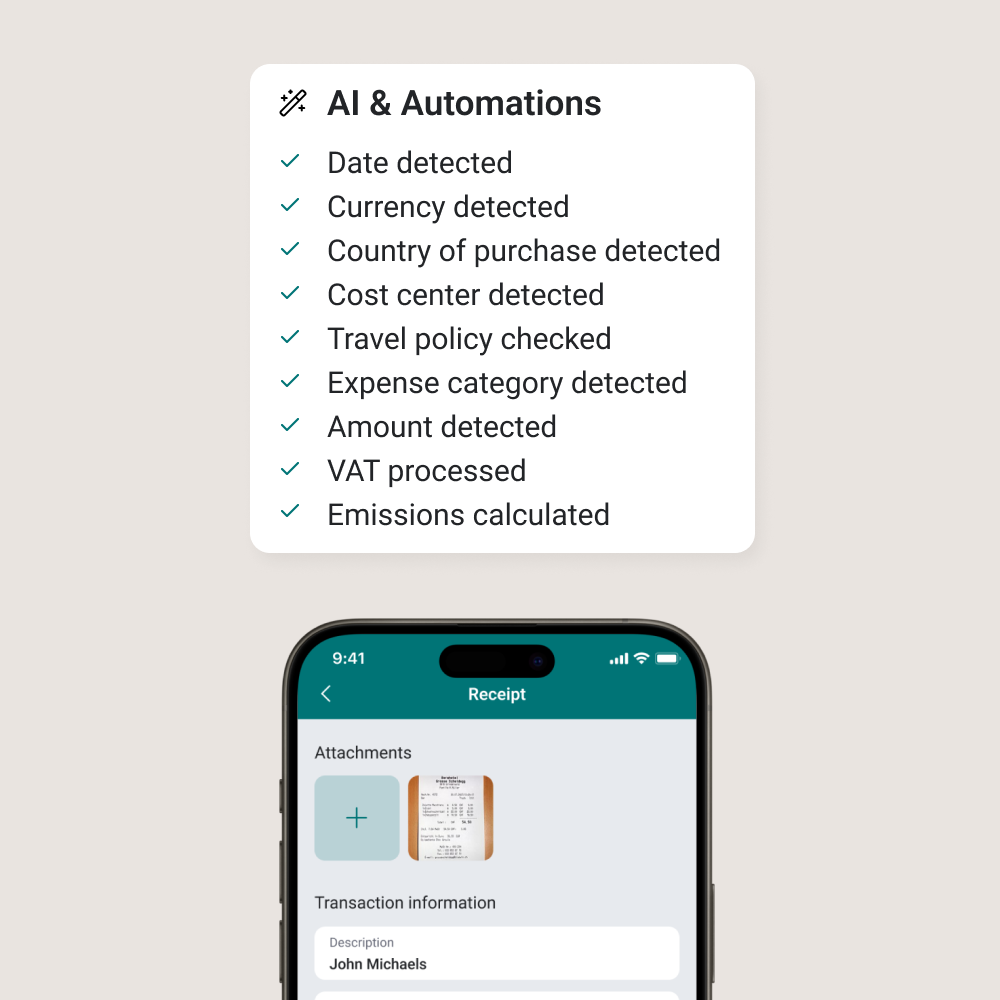
Accurate measurement enables better decisions. When employees and managers can see the carbon impact of travel choices alongside cost, behaviour changes. Integrating emissions data into the expense and approval workflow, rather than treating it as a separate sustainability report produced once a year, creates real-time accountability. Tools like Bezala that consolidate travel-related expenses and mileage reimbursements in one platform give finance teams the activity data needed to calculate and monitor category 6 emissions with greater precision.
Reduction targets should be grounded in a baseline measurement. Without knowing the current level of category 6 emissions, it is impossible to set meaningful reduction goals or track progress. Starting with a rigorous data collection exercise, even if imperfect, is always more valuable than waiting for perfect data before acting.
This content was generated with the help of AI and it may contain mistakes