
Scope 3 emissions from business travel are the greenhouse gas emissions produced by employee travel for work purposes using transportation that the company does not own or directly control. These emissions fall under Category 6 of the Greenhouse Gas Protocol’s Scope 3 framework, which covers flights, trains, rental cars, taxis, and other modes of transport employees use when travelling on behalf of their employer. This article unpacks how business travel fits into Scope 3, how emissions are calculated, why measurement is difficult, and what companies can do about it.
How does business travel fit into Scope 3 emissions?
Business travel fits into Scope 3 emissions because it involves indirect emissions generated by activities connected to a company’s operations but occurring outside its direct ownership. Scope 3 is the broadest of the three emission scopes defined by the Greenhouse Gas Protocol, and it captures upstream and downstream activities that a company influences but does not control. Employee travel on planes, trains, and rental vehicles produces carbon emissions that the company is responsible for tracking even though it does not own the aircraft or vehicles.
The three-scope framework works as follows: Scope 1 covers direct emissions from sources a company owns, such as a company-owned vehicle fleet. Scope 2 covers indirect emissions from purchased electricity and heat. Scope 3 covers everything else, including supplier emissions, waste, employee commuting, and business travel. For many service-sector companies, Scope 3 is by far the largest portion of their total carbon footprint, and business travel is often one of the most significant contributors within that category.
Because Scope 3 emissions are indirect, companies cannot reduce them simply by switching to renewable energy or upgrading their own equipment. Reducing business travel emissions requires influencing employee behaviour, supplier choices, and travel policies, which makes Category 6 one of the more complex areas of corporate climate action.
What types of travel count as Scope 3 Category 6?
Scope 3 Category 6 covers all modes of transportation used by employees travelling for business purposes, where the company does not own or operate the vehicle. This includes flights, train journeys, bus travel, rental cars, taxis, rideshare services, ferries, and personal vehicles used for business trips. Hotel stays are sometimes included in broader corporate travel emissions reporting, but accommodation is typically accounted for separately under Category 6 or related categories depending on the framework used.
The key criterion is that the travel must be work-related and undertaken on behalf of the employer. Commuting between home and a regular workplace is excluded from Category 6 and instead falls under Category 7, which covers employee commuting. Business travel under Category 6 specifically refers to trips made for meetings, conferences, client visits, site inspections, and similar professional purposes.
Air travel typically dominates Category 6 emissions for companies with international operations, since long-haul flights produce significantly more emissions per kilometre than ground-based alternatives. However, high-frequency short-haul flights and extensive domestic travel can also accumulate substantial carbon emissions over a reporting year.
How are Scope 3 business travel emissions calculated?
Scope 3 business travel emissions are calculated by multiplying the activity data for each journey by an appropriate emission factor. Activity data refers to measurable units such as kilometres travelled, passenger-kilometres flown, or nights stayed in accommodation. Emission factors, which convert activity data into carbon dioxide equivalent (CO2e) figures, are published by national governments, the International Energy Agency, and organisations such as the UK’s Department for Energy Security and Net Zero.
In practice, companies use one of three approaches to gather the underlying data:
- Spend-based method: Total expenditure on flights, hotels, and ground transport is multiplied by an emissions intensity factor expressed in CO2e per unit of currency. This is the simplest approach but the least accurate.
- Distance-based method: Actual or estimated distances for each journey are multiplied by mode-specific emission factors. This is more accurate and is preferred when travel booking data is available.
- Supplier-specific method: Emissions data is sourced directly from airlines or travel management companies, which increasingly provide per-flight or per-booking carbon estimates. This is the most precise approach but depends on supplier cooperation.
For air travel, radiative forcing is an important additional consideration. Aircraft emissions at altitude have a warming effect beyond CO2 alone, and some frameworks recommend applying a multiplier to account for this. The Greenhouse Gas Protocol allows but does not require this adjustment, so companies should document clearly which methodology they apply.
Why are business travel emissions hard to measure accurately?
Business travel emissions are hard to measure accurately because the data is fragmented across multiple systems, booking platforms, expense reports, and employee records. Unlike Scope 1 emissions, which come from sources a company directly monitors, Category 6 emissions depend on collecting consistent, detailed information from employees who may book travel through different channels or claim reimbursements weeks after a trip takes place.
Several factors compound this difficulty:
- Multiple booking channels: Employees may book flights directly with airlines, through corporate travel management systems, or via consumer platforms, making centralised data collection inconsistent.
- Incomplete expense data: Expense claims often record only the cost of travel, not the route, distance, or mode, which makes distance-based calculations impossible without additional data enrichment.
- Varied emission factors: Different emission factor databases use different assumptions, and factors change over time as transport technology evolves, making year-on-year comparisons unreliable if methodologies shift.
- Mixed-mode journeys: A single business trip may involve a flight, a train connection, and a taxi, each requiring a separate emission factor and data source.
- Personal vehicle use: When employees use their own cars for business travel and claim mileage reimbursements, the vehicle’s fuel type and efficiency are often unknown, requiring the use of average fleet assumptions.
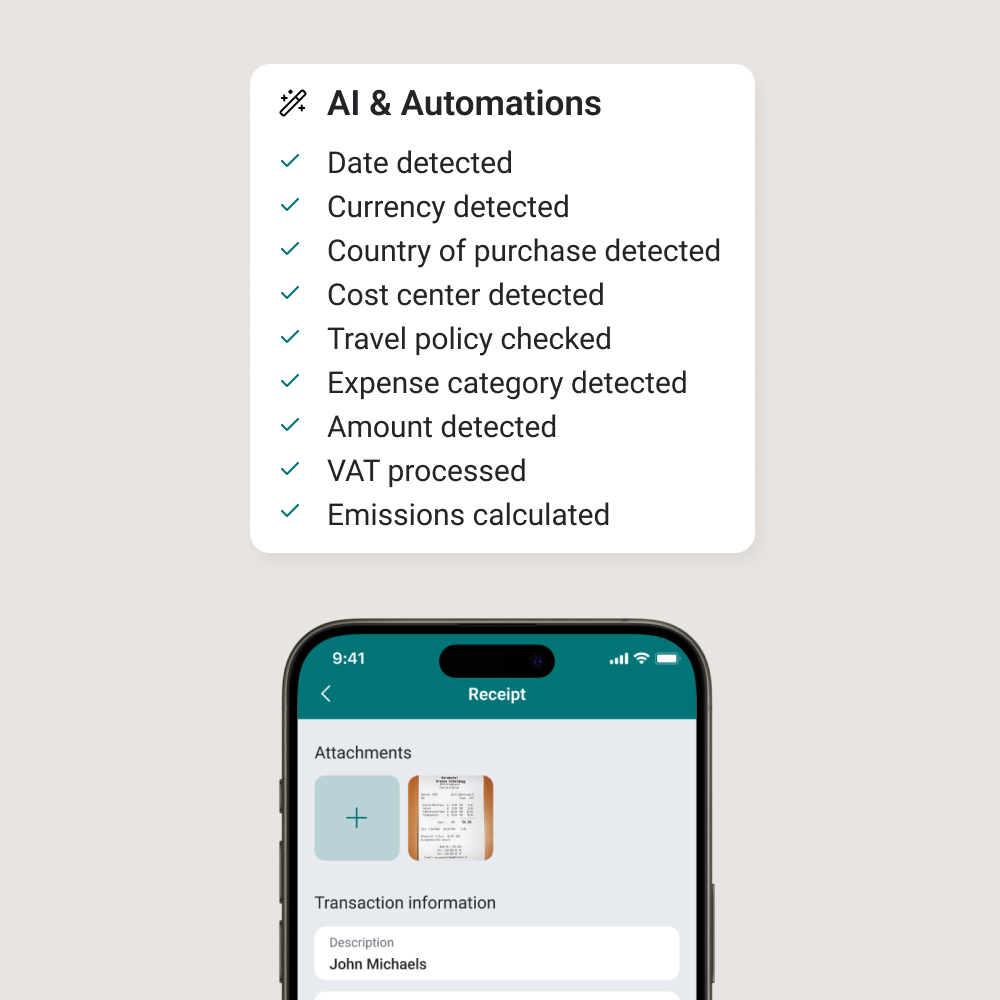
Connecting travel expense data to emissions calculations automatically, rather than relying on manual reconciliation, is one of the most effective ways companies reduce measurement error. Platforms that capture structured expense data at the point of submission make it significantly easier to extract the activity data needed for accurate carbon accounting.
What are the reporting requirements for Scope 3 travel emissions?
Reporting requirements for Scope 3 business travel emissions vary by jurisdiction, company size, and the reporting framework a company has committed to, but the direction across major markets is clearly toward mandatory disclosure. As of 2026, the most significant regulatory developments affecting European companies include the EU Corporate Sustainability Reporting Directive (CSRD), which requires large and listed companies to report Scope 3 emissions under the European Sustainability Reporting Standards (ESRS). Category 6 business travel is a named disclosure area within those standards.
Beyond regulatory mandates, several voluntary frameworks shape how companies report travel emissions:
- Greenhouse Gas Protocol Corporate Standard: The foundational methodology for Scope 1, 2, and 3 accounting, widely referenced by other frameworks.
- Science Based Targets initiative (SBTi): Companies setting SBTi-aligned targets are required to include Scope 3 categories that represent more than 40% of total emissions, which often includes business travel.
- CDP (formerly Carbon Disclosure Project): Companies disclosing through CDP are asked to report Scope 3 emissions by category, including Category 6.
- ISO 14064: An international standard for quantifying and reporting greenhouse gas emissions that some companies use alongside or instead of the GHG Protocol.
Companies subject to CSRD should note that the standard requires not just emissions data but also information on targets, reduction measures, and governance around climate-related risks. Business travel policy and carbon reduction initiatives therefore become part of the formal audit trail, not just internal sustainability metrics.
How can companies reduce Scope 3 emissions from business travel?
Companies can reduce Scope 3 emissions from business travel by combining travel policy changes, modal shift strategies, carbon offsetting, and better data infrastructure to track and manage their travel carbon footprint. Reduction requires both influencing when and how employees travel and ensuring the organisation has accurate enough data to measure whether interventions are working.
Travel policy and behavioural change
The most direct lever is reducing the volume of high-emission journeys. Many companies have introduced policies that require employees to consider video conferencing as an alternative to in-person meetings, particularly for short or routine interactions. Some organisations set carbon budgets per employee or per department, creating accountability at the team level rather than relying solely on top-down mandates. Requiring pre-approval for flights, especially short-haul routes where rail is available, is another common and effective policy measure.
Modal shift and supplier selection
Shifting travel from higher-emission to lower-emission modes produces measurable reductions without eliminating travel entirely. Replacing short-haul flights with train journeys is one of the most impactful changes available to European companies, given the significant difference in emissions per passenger-kilometre between air and rail. When air travel is necessary, choosing direct routes over connections reduces emissions because take-off and landing are the most fuel-intensive phases of a flight. Selecting accommodation and ground transport suppliers with verified sustainability credentials also contributes to reducing the overall travel carbon footprint.
Carbon offsetting and insetting
Where travel cannot be eliminated or substituted, carbon offsetting allows companies to compensate for residual emissions by funding verified emission reduction projects elsewhere. High-quality offsets are certified by standards such as Gold Standard or Verified Carbon Standard. Carbon insetting, a related approach, involves investing in emission reductions within a company’s own value chain rather than in unrelated projects. Both approaches are considered supplementary to direct reduction, not a substitute for it.
Accurate data is the foundation of any effective reduction strategy. Without reliable visibility into which trips, routes, and departments are generating the most emissions, companies cannot prioritise action or demonstrate progress. Structuring expense management so that travel claims capture route and mode information, rather than just cost, gives finance and sustainability teams the data they need to make informed decisions. Tools like Bezala’s expense platform help organisations centralise travel expense data, which is a practical starting point for building the activity data needed for credible Scope 3 reporting.
This content was generated with the help of AI and it may contain mistakes