A carbon offset strategy for corporate travel programs is a structured plan that measures the greenhouse gas emissions produced by business travel, then funds verified projects that reduce or remove an equivalent amount of carbon from the atmosphere. It gives companies a way to take responsibility for emissions they cannot yet eliminate through behavior change or cleaner transport choices alone.
The strategy works best when it sits alongside a broader effort to reduce travel emissions at the source, not as a substitute for it. Most corporate programs combine emissions measurement, supplier engagement, and offset purchasing into a single policy that finance and sustainability teams manage together. The sections below unpack the key questions every company needs to answer when building or refining that approach.
How do carbon offsets actually work in corporate travel?
Carbon offsets work by funding external projects that prevent or remove greenhouse gas emissions equivalent to those a company produces through business travel. When a company buys an offset, it is paying for a measurable unit of carbon reduction, typically one tonne of CO2 equivalent, achieved somewhere else in the world while its own travel emissions remain on the books.
In practice, a company calculates the emissions generated by flights, rail journeys, and ground transport taken by employees during a given period. It then purchases a matching volume of offsets from a project portfolio, such as a forest protection scheme or a renewable energy installation. The offset provider retires those credits in a public registry so they cannot be sold again, giving the company a verifiable claim that its travel emissions have been compensated.
The mechanism does not erase emissions. It creates an accounting balance between what was released and what was reduced or sequestered elsewhere. This distinction matters for how companies communicate their climate commitments, particularly as reporting standards tighten across Europe and beyond.
What types of carbon offset projects do companies typically use?
Companies building a corporate travel carbon offset strategy most commonly use four categories of offset project: forestry and land use, renewable energy, methane capture, and direct air capture. Each category carries different cost levels, permanence characteristics, and co-benefits for local communities and biodiversity.
Nature-based projects
Forestry projects, including avoided deforestation schemes known as REDD+, are among the most widely used offsets in corporate programs. They protect standing forests that would otherwise be cleared, preventing the release of stored carbon. Reforestation and soil carbon projects also fall into this category. Nature-based offsets tend to be lower cost and deliver biodiversity and community benefits, but they carry permanence risk if forests are later destroyed by fire or land use change.
Technology-based projects
Renewable energy projects, such as wind farms or solar installations in developing markets, displace fossil fuel generation and produce credits for the emissions avoided. Methane capture projects collect gas from landfills or agricultural operations before it enters the atmosphere. At the premium end, direct air capture technology physically removes CO2 from the air and stores it permanently, though these credits cost significantly more per tonne and are used mainly by companies with ambitious net-zero commitments.
What’s the difference between carbon offsets and carbon credits?
Carbon offsets and carbon credits both represent one tonne of CO2 equivalent, but they originate from different systems. Carbon offsets are generated by voluntary projects and purchased by companies choosing to compensate for their emissions outside any regulatory obligation. Carbon credits are issued within compliance markets, such as the EU Emissions Trading System, where regulated industries must surrender credits to cover their mandatory emission allowances.
For most corporate travel programs, the relevant instrument is the voluntary carbon offset. Companies are not legally required to offset travel emissions in most jurisdictions, so they operate in the voluntary carbon market, selecting projects based on quality standards, co-benefits, and alignment with their sustainability goals. Compliance credits from regulated markets are generally not available or appropriate for voluntary corporate use.
The terminology is often used interchangeably in business contexts, which creates confusion. When evaluating a carbon offset strategy for a corporate travel program, it is worth confirming that any credits purchased are voluntary market offsets verified under a recognized standard, not compliance instruments from a regulated trading scheme.
How do companies measure travel emissions before offsetting?
Companies measure corporate travel emissions by applying standardized emission factors to travel activity data, typically distance traveled multiplied by a factor specific to the transport mode and class of service. This calculation produces a figure in tonnes of CO2 equivalent, which becomes the baseline for offset purchasing.
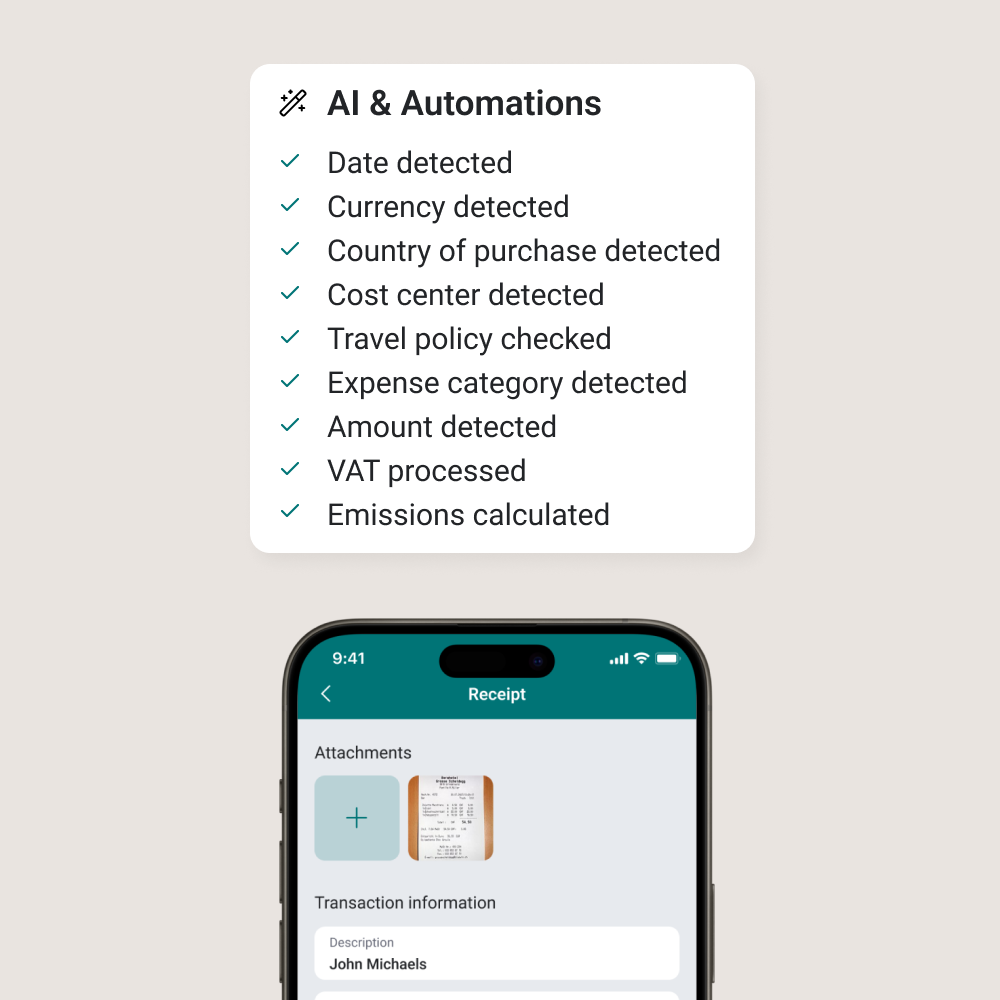
The data inputs come from several sources: corporate travel booking systems, expense reports, company card transaction records, and airline invoices. Flight emissions are the largest contributor for most programs and are calculated using distance, aircraft type, cabin class, and a radiative forcing multiplier that accounts for the additional warming effect of contrails at altitude. Ground transport, hotel stays, and rail travel are added to build a complete travel footprint.
Accuracy depends heavily on data quality. Companies that manage travel expenses through a centralized platform have a significant advantage because the underlying spend and trip data is already structured and auditable. Without consolidated data, finance teams often rely on estimates and averages that understate actual emissions. Establishing clean data collection before committing to an offset volume is a foundational step that many programs take too early.
Which carbon offset standards should a corporate travel program trust?
The most trusted carbon offset standards for corporate travel programs are the Verified Carbon Standard, known as Verra or VCS, and the Gold Standard. Both require independent third-party auditing, public project registries, and retirement tracking to ensure credits are not double-counted. A corporate travel program should only purchase offsets certified under one of these frameworks or an equivalent recognized scheme.
Verra’s VCS is the largest voluntary carbon standard by volume and covers a wide range of project types, making it the most common choice for corporate buyers. The Gold Standard was developed with input from environmental organizations and places additional weight on sustainable development co-benefits, making it a strong choice for companies that want to demonstrate community and biodiversity impact alongside carbon reduction.
Additional quality signals to look for include whether the project has been verified under the Social Carbon Standard or Climate, Community and Biodiversity Standards for nature-based projects, and whether the registry publicly records credit retirement in real time. Purchasing offsets through a reputable broker or directly from project developers who publish their methodology and audit reports reduces the risk of buying credits that do not represent genuine reductions.
Should companies offset travel emissions or reduce them first?
Companies should reduce travel emissions first and offset what remains after genuine reduction efforts have been made. Offsetting before attempting to reduce travel volume or switch to lower-emission transport options undermines the credibility of a corporate climate commitment and delays the structural changes that drive lasting impact.
The widely accepted hierarchy for corporate emissions management follows a mitigation-first sequence. Companies start by eliminating unnecessary travel through better use of video conferencing and remote collaboration tools. They then shift remaining travel to lower-emission modes where feasible, such as rail instead of short-haul flights. Next, they work with travel suppliers to choose airlines and operators with credible fleet efficiency or sustainable aviation fuel programs. Offsetting sits at the end of this sequence as a way to address residual emissions that cannot yet be eliminated.
This approach matters for reporting credibility as well. Frameworks such as the Science Based Targets initiative explicitly discourage using offsets to compensate for emissions that should be reduced directly. As corporate sustainability reporting becomes more standardized across European markets in 2026, companies that rely heavily on offsets without demonstrating reduction progress face growing scrutiny from investors, customers, and regulators alike.
A well-designed carbon offset strategy for a corporate travel program is therefore not primarily about buying credits. It is about building the data infrastructure to measure accurately, the governance to reduce systematically, and the purchasing discipline to offset credibly when reduction has reached its practical limit for now.
This content was generated with the help of AI and it may contain mistakes