
A corporate card is a payment card issued by a company to its employees, allowing them to make business-related purchases directly without using personal funds. The company, not the individual employee, is ultimately responsible for the charges. Corporate cards are designed to simplify expense management, reduce the administrative burden of reimbursements, and give finance teams real-time visibility into company spending. This article unpacks how corporate cards work, who qualifies for one, and how companies keep spending under control.
How does a corporate card actually work?
A corporate card works by linking a payment card to a company account, so purchases made by an employee are billed directly to the business. The cardholder uses it like any standard payment card, but the liability and repayment responsibility sit with the employer rather than the individual. The company sets spending limits, approved categories, and usage policies before cards are issued.
When an employee makes a purchase, the transaction is recorded against the company account and typically needs to be matched with a receipt or expense report. Finance teams can review transactions once they receive the invoice from credit card company, and reconcile charges at the end of each billing period. Many modern platforms automate much of this process, capturing receipt data and routing it directly into accounting systems without manual data entry.
Corporate cards are issued through major payment networks such as Visa or Mastercard, which means they are accepted at millions of merchants globally. Some programs, like Bezala Card, go further by integrating the card directly with expense management software, so the transactions can be viewed in real time, and every transaction is automatically connected to the corresponding receipt and accounting entry from the moment of purchase.
What’s the difference between a corporate card and a business credit card?
The key difference between a corporate card and a business credit card is who holds the liability. With a corporate card, the company is fully liable for all charges. With a business credit card, liability often falls on the individual business owner or, in some cases, is shared between the individual and the business. Corporate cards are also typically issued to multiple employees across an organization, while business credit cards are more commonly used by sole traders or small business owners.
Corporate cards tend to come with more sophisticated controls, such as per-employee spending limits, category restrictions, and integration with enterprise finance systems. Business credit cards, by contrast, are simpler products closer to a personal credit card in structure, often with rewards programs and lower eligibility thresholds.
Another practical distinction is reporting. Corporate card programs are designed with finance teams in mind, offering detailed transaction data, automated reconciliation, and audit trails. Business credit cards typically provide basic monthly statements without the deeper administrative infrastructure that larger organizations require.
Who is eligible to get a corporate card?
Eligibility for a corporate card is determined by the issuing bank or card provider, and the criteria apply to the company rather than the individual employee. The business typically needs to meet minimum revenue thresholds, demonstrate creditworthiness, and have a registered legal entity. Employees receive cards as an extension of the company’s approved program, not through individual credit checks.
In practice, corporate card programs are most commonly available to mid-sized and large organizations, though some providers now offer programs suited to smaller businesses as well. The employee who receives a card does not need to have a strong personal credit history, since the financial obligation rests with the employer.
Companies decide internally which employees are issued cards, typically prioritizing those who travel frequently, manage vendor relationships, or regularly make business purchases. Finance teams set the parameters, and the card issuer fulfills the request within the company’s approved account structure.
What are the main types of corporate cards?
The main types of corporate cards are corporate credit cards, corporate charge cards, corporate debit cards, and prepaid corporate cards. Each works differently in terms of how funds are accessed and when payment is due.
- Corporate credit cards: Allow employees to make purchases on credit, with the balance settled by the company at the end of each billing cycle. These are the most common type and offer the most flexibility for managing cash flow.
- Corporate charge cards: Similar to credit cards but require the full balance to be paid at the end of each month with no option to carry a balance. These encourage tighter spending discipline.
- Corporate debit cards: Linked directly to a company bank account, so funds are deducted immediately. There is no credit element, which limits exposure but also limits flexibility.
- Prepaid corporate cards: Loaded with a set amount of funds in advance. They are useful for giving employees controlled budgets for specific projects or trips without access to a broader credit line.
The right type depends on the company’s financial structure, employee needs, and the level of control the finance team wants to maintain over day-to-day spending.
What expenses can a corporate card be used for?
A corporate card can be used for any legitimate business expense, though companies typically define approved categories in their expense policy. Common uses include travel bookings, hotel accommodation, meals with clients, office supplies, software subscriptions, and fuel for business travel. The card should never be used for personal purchases.
Most organizations publish a clear expense policy that specifies which categories are permitted, any per-transaction or per-day limits, and what documentation is required. Employees are expected to submit receipts for all purchases, and finance teams match these against card transactions during reconciliation.
Some corporate card programs allow companies to restrict spending at the card level, blocking certain merchant categories entirely. This means a card configured for travel expenses, for example, can be prevented from processing transactions at non-travel merchants, reducing the risk of misuse without relying solely on policy enforcement after the fact.
How do companies track and control corporate card spending?
Companies track and control corporate card spending through a combination of spending limits, category restrictions, real-time transaction monitoring, and expense management software. Finance teams can set rules at the card level, review transactions as they happen, and require employees to submit receipts that are matched against each charge before the expense is approved.
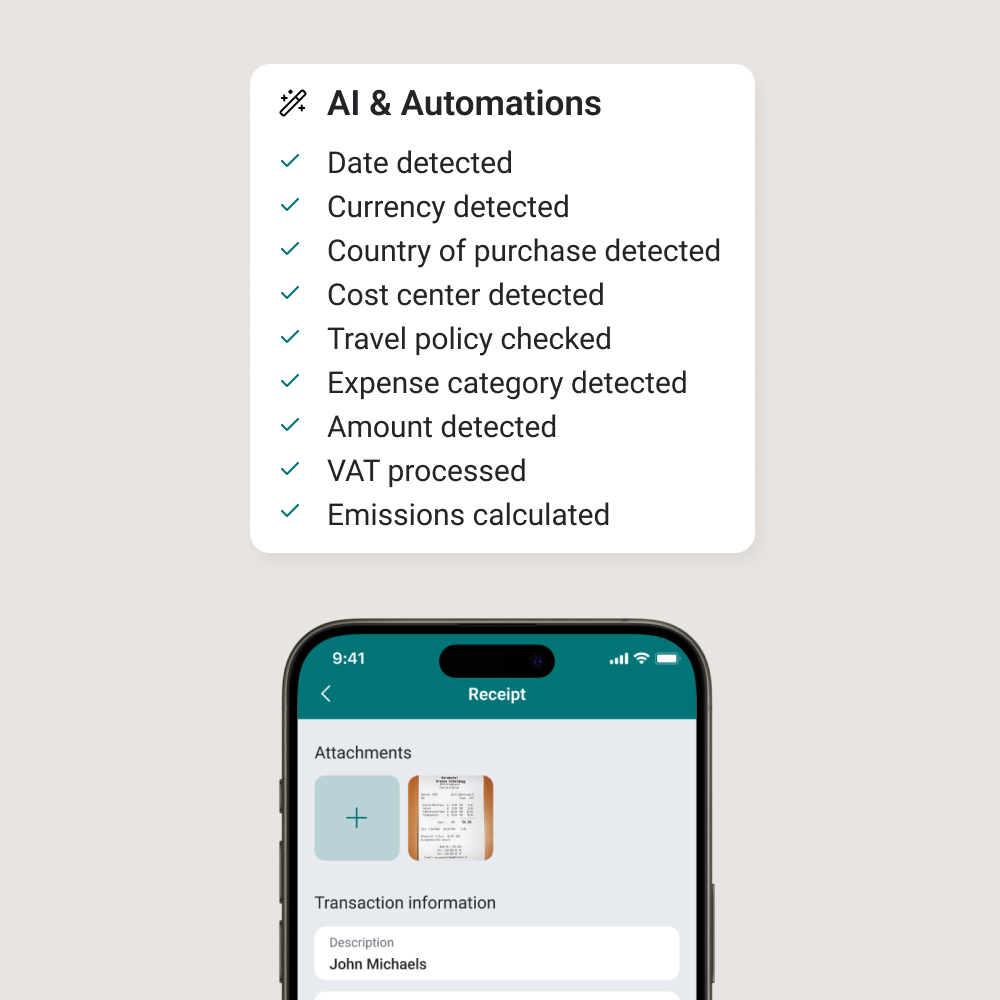
Modern expense management platforms have made this process significantly more efficient. Instead of collecting paper receipts and manually entering data into spreadsheets, employees can photograph a receipt immediately after a purchase and the system extracts the relevant details automatically. Transactions from the corporate card feed directly into the platform, and the two are matched without manual intervention.
Approval workflows add another layer of control. Transactions above a certain value can be automatically routed to a manager or finance lead for review before they are posted to the accounts. Automated reminders prompt employees to submit missing receipts, reducing the administrative follow-up that finance teams would otherwise have to handle manually.
For companies operating across multiple countries, the ability to configure separate rules and approval flows for each market is particularly valuable. Expense policies, tax requirements, and per diem rates vary by country, and a platform that handles these differences automatically removes a significant compliance burden from the finance team.
This content was generated with the help of AI and it may contain mistakes