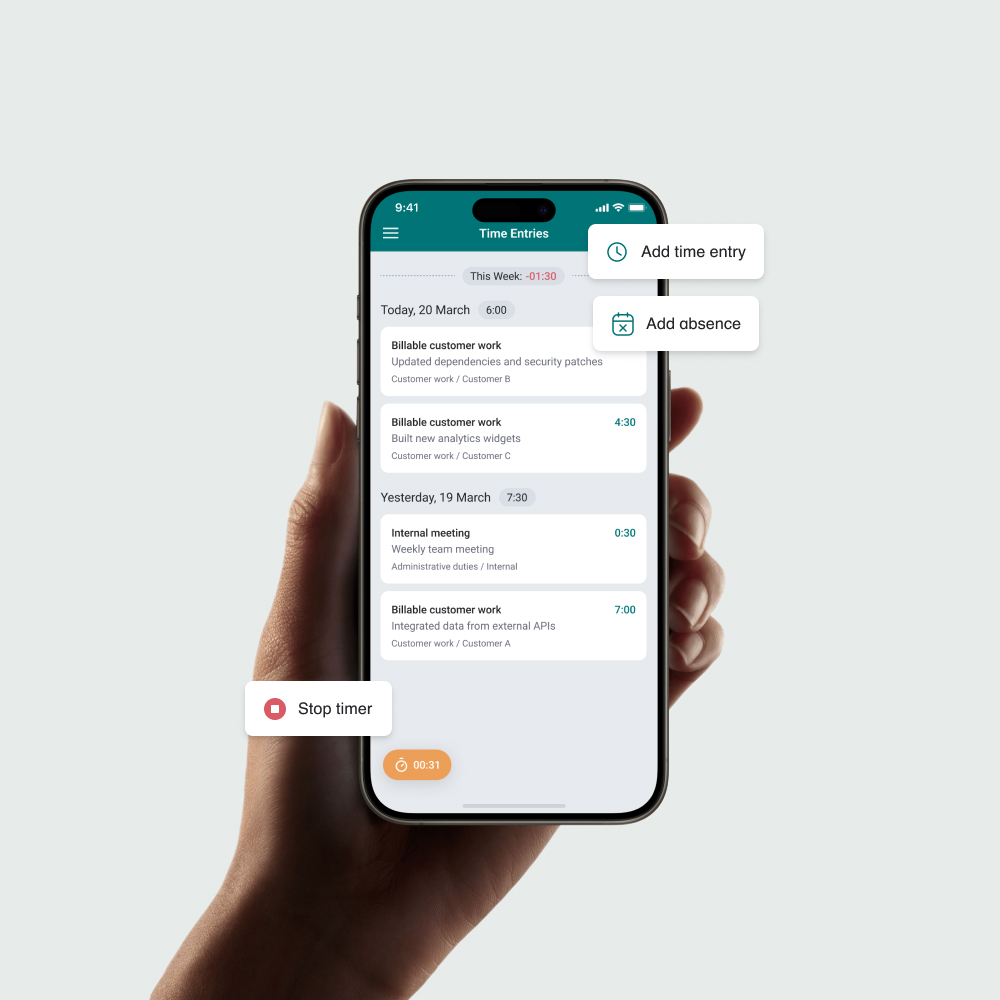


Time tracking and attendance management are related but distinct workforce tools. Time tracking records how long employees spend on specific tasks, projects, or clients, while attendance management monitors whether employees are present, absent, or on leave during scheduled working hours. The key difference is focus: time tracking answers “what were you working on?”, attendance management answers “were you at work?”
Most organizations need both, but they serve different operational purposes and feed into different business processes. The sections below break down exactly what each system measures, where they are used, and how to decide what your organization actually needs.
What does each system actually measure?
Time tracking measures the duration and allocation of work: how many hours an employee spent on a task, a project, a client account, or a cost center. Attendance management measures presence and absence against a defined work schedule: whether an employee clocked in on time, took approved leave, or was absent without notice.
The distinction becomes clearer when you look at the underlying data each system produces. A time tracking system generates records like “Employee A worked 3.5 hours on Project X and 2 hours on Project Y on Tuesday.” An attendance management system generates records like “Employee A was present from 08:45 to 17:00, took 30 minutes of sick leave last Thursday, and has 12 days of annual leave remaining.”
Time tracking data is primarily forward-looking for operational decisions: billing, project costing, resource allocation. Attendance data is primarily compliance-oriented: payroll accuracy, labor law adherence, absence trend monitoring. Both deal with working hours, but they measure fundamentally different dimensions of employee work.
What are the main use cases for time tracking?
Time tracking is primarily used for project costing, client billing, payroll calculation, and workforce productivity analysis. Any organization that needs to know where working hours go, not just whether employees showed up, relies on time tracking to allocate costs accurately and manage workloads effectively.
The most common use cases include:
- Client billing: Professional services firms, agencies, and consultancies log billable hours per client to generate accurate invoices and protect revenue.
- Project cost management: Tracking hours against project budgets helps managers identify scope creep early and keep projects financially on track.
- Payroll for variable-hour employees: Organizations with part-time, hourly, or shift-based staff use time tracking to calculate wages accurately each pay period.
- Resource planning: Knowing how hours are distributed across teams and projects makes future staffing decisions more evidence-based.
- Overtime and compliance: Many labor regulations require employers to document working hours to demonstrate compliance with maximum hour rules.
Employee time tracking is also valuable for remote and hybrid teams, where visibility into how work is distributed can be difficult to maintain through observation alone.
What are the main use cases for attendance management?
Attendance management is primarily used for absence tracking, leave management, shift scheduling, and payroll deduction calculations. It answers questions about workforce availability and reliability rather than how productive time is spent.
Core use cases include:
- Leave and absence tracking: Recording annual leave, sick days, parental leave, and other approved absences to maintain accurate entitlement balances.
- Shift and schedule compliance: Monitoring whether employees are working their scheduled shifts, arriving on time, and not exceeding contracted hours.
- Payroll deductions: Feeding absence data directly into payroll so that unpaid leave or sick pay policies are applied correctly.
- Legal reporting: Many jurisdictions require employers to maintain records of employee working time and absences to satisfy labor law obligations.
- Absence pattern analysis: HR teams use attendance data to identify trends such as frequent short-term absences that may indicate underlying well-being or engagement issues.
Attendance management becomes especially important in industries with strict scheduling requirements: healthcare, retail, manufacturing, and logistics, where a missing employee has immediate operational consequences.
Can time tracking and attendance management overlap?
Yes, time tracking and attendance management overlap significantly in practice, and many modern workforce management platforms combine both functions. The overlap occurs because the raw data, hours worked per day, is shared, even though each system uses that data for different purposes.
When an employee logs their start and end time for the day, that single action can simultaneously record their attendance for the day and provide a basis for time allocation. Similarly, overtime tracking sits at the intersection of both: it is a time tracking concern (how many hours were worked) and an attendance concern (was the employee scheduled to be there?).
The practical overlap means that organizations often find it inefficient to run two entirely separate systems. A combined platform can capture a clock-in event and use it to confirm attendance while also prompting the employee to allocate their hours to projects or cost centers. This reduces double entry and improves data consistency across HR, finance, and operations.
That said, the overlap does not make the two functions identical. A project-focused team in a consulting firm may need detailed time tracking with no shift-based attendance management. A retail business may need precise attendance and scheduling tools with minimal project-level time allocation. The overlap is real, but the emphasis varies by organization type.
Which does your organization actually need?
Most organizations need both, but the priority depends on your industry, workforce structure, and primary pain point. If your core challenge is billing clients accurately or controlling project costs, time tracking is the more critical investment. If your challenge is managing shift coverage, absence rates, or payroll accuracy for a scheduled workforce, attendance management takes priority.
A practical way to decide is to ask where errors or inefficiencies currently cost you the most:
- If projects regularly run over budget or clients dispute invoices, your gap is time tracking.
- If payroll errors stem from incorrect leave balances or missed shifts, your gap is attendance management.
- If you struggle with both, a unified platform that handles time entry, project allocation, and absence tracking in one place eliminates the friction of maintaining separate systems.
For organizations with a mix of project-based and scheduled work, an integrated approach makes the most sense. Bezala’s time and attendance functionality brings hour logging, project tracking, and absence reporting onto the same platform as expense management, so employees handle all work-related tracking in a single application rather than switching between tools.
The right answer ultimately comes down to where your workforce spends its time and how that time connects to your billing, payroll, and compliance obligations. Start with the function that directly affects your most pressing operational or financial risk, and build from there.
This content was generated with the help of AI and it may contain mistakes