

Accurate work-hour tracking is important for employers in 2026 because it protects businesses from legal liability, ensures employees are paid correctly, and gives finance teams the data they need to control labor costs. Labor law requirements across Europe and beyond have grown stricter, meaning the margin for error is smaller than ever. The sections below answer the most pressing questions employers have about time tracking compliance, payroll accuracy, and when to upgrade their systems.
What are employers legally required to track in 2026?
Employers are legally required to record each employee’s daily and weekly working hours, including start and end times, rest breaks, and overtime. In the European Union, the Working Time Directive establishes these obligations, and national labor laws in member states add further specificity. Non-compliance is not a technicality; it is a legal exposure that labor authorities actively audit.
In practice, this means employers must maintain records that can demonstrate an employee’s total hours worked in any given week, that rest periods were respected, and that statutory limits on working time were not exceeded. Many countries also require records to be retained for a defined number of years, often between two and five, so that historical disputes can be resolved with documented evidence.
The scope of what must be tracked has also broadened. Remote and hybrid work arrangements mean that home-based hours carry the same legal weight as office hours. Employers cannot rely on physical presence as a proxy for time worked. Any system that cannot capture hours regardless of location creates a compliance gap that puts the employer at risk.
What are the consequences of inaccurate work-hour records?
Inaccurate work-hour records expose employers to financial penalties, back-pay claims, and reputational damage. Labor authorities can impose fines for record-keeping failures even when no deliberate wrongdoing occurred. Employees who believe they have been underpaid for overtime or denied rest periods can bring claims that result in costly settlements or tribunal awards.
Beyond direct financial consequences, inaccurate records damage trust. When employees discover discrepancies between hours worked and hours paid, morale drops and turnover rises. The cost of replacing an employee who leaves over a pay dispute typically far exceeds the cost of implementing a reliable time-tracking system in the first place.
There is also an audit-risk dimension. Tax authorities and social security bodies in many countries cross-reference payroll data with hours worked to verify that contributions are correctly calculated. Gaps or inconsistencies in time records can trigger broader investigations into payroll practices, creating administrative burdens that consume significant management time.
How does accurate time tracking affect payroll and cost control?
Accurate time tracking directly determines whether payroll is calculated correctly and whether labor costs are allocated to the right projects or cost centers. When hours are recorded precisely, payroll runs faster, errors are caught before payment is made, and finance teams can reconcile labor costs against budgets in real time rather than after the fact.
From a cost-control perspective, reliable hour data reveals patterns that manual or approximate records obscure. Managers can see which projects are consuming more labor than planned, which teams are consistently working overtime, and where scheduling adjustments could reduce unnecessary costs. Without accurate records, these decisions are made on instinct rather than evidence.
For companies that bill clients based on hours worked, the stakes are even higher. Undercounting billable hours means revenue is left on the table. Overcounting creates disputes and damages client relationships. Accurate employee time tracking is therefore not just an internal compliance matter but a direct driver of revenue integrity.
What’s the difference between manual and automated work-hour tracking?
Manual time tracking relies on employees recording their own hours in spreadsheets, paper timesheets, or basic digital forms. Automated time tracking uses software to capture, store, and process hours with minimal manual input. The core difference is accuracy and reliability: manual systems depend on memory and discipline, while automated systems record data at the point of action.
Where manual tracking falls short
Manual systems are prone to rounding errors, forgotten entries, and deliberate or unintentional manipulation. When an employee fills in a timesheet at the end of the week, they are reconstructing memory rather than recording fact. Discrepancies accumulate over time and are difficult to detect until a dispute or audit forces a review. Manual records are also harder to aggregate, making payroll processing and reporting slower and more error-prone.
What automated tracking delivers
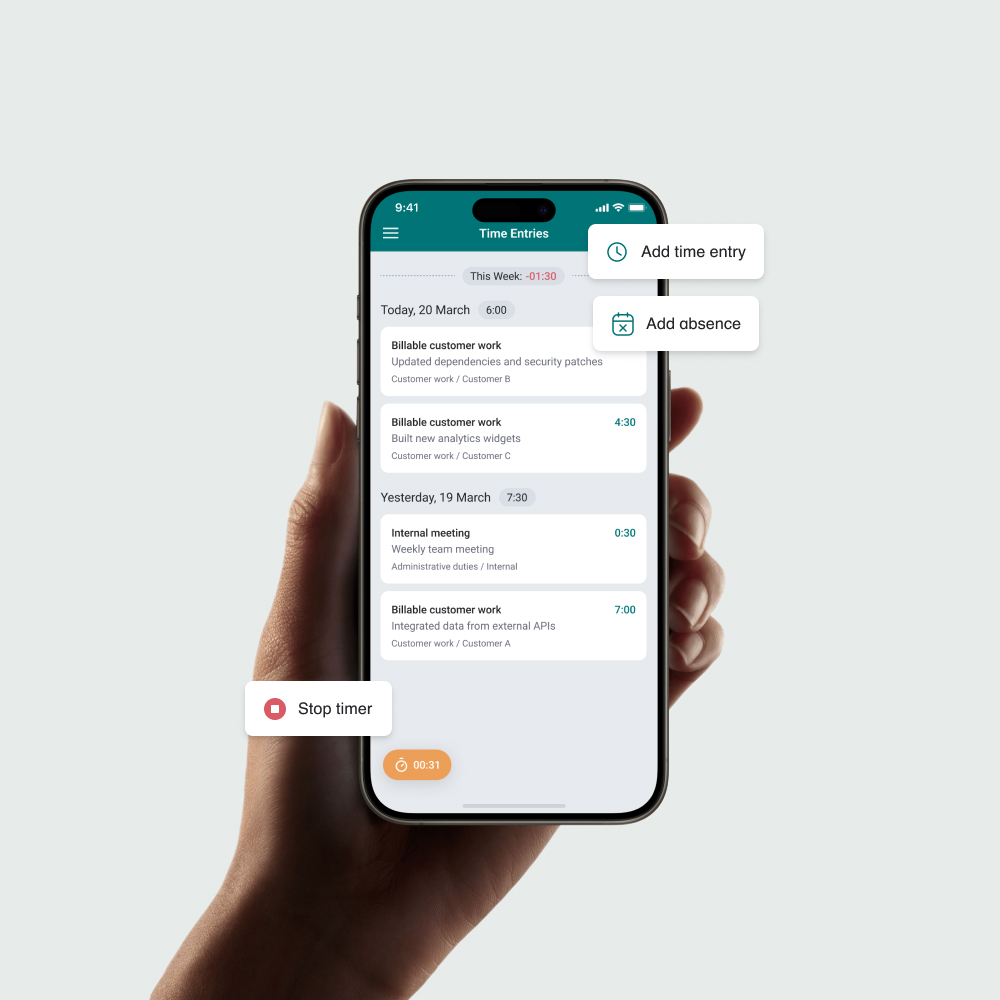
Automated work-hour tracking captures entries in real time, enforces consistent formatting, and integrates directly with payroll and accounting systems. Managers gain visibility into current hour balances without chasing employees for updates. Approval workflows ensure that hours are reviewed before they reach payroll, reducing the risk of errors being processed unchecked. Bezala’s time and attendance service, for example, lets employees log hours from a mobile device or browser and gives managers live visibility into hour balances and billable hours, all within the same platform used for expense management.
Who is responsible for ensuring work hours are tracked correctly?
The legal responsibility for maintaining accurate work-hour records rests with the employer, not the employee. While employees are expected to record their hours honestly, the employer is obligated to provide a system that makes accurate recording possible and to verify that records are complete and credible. An employer cannot shift liability to employees by pointing to a timesheet policy that was never properly enforced.
In practice, responsibility is distributed across three levels. Employees are responsible for submitting their hours accurately and on time. Line managers are responsible for reviewing and approving those hours, flagging anomalies, and ensuring their teams comply with working time rules. Finance and HR teams are responsible for maintaining the system, running audits, and ensuring records meet legal retention requirements.
When accountability is unclear, records deteriorate. Organizations that treat time tracking as an employee-only task without managerial oversight consistently produce less reliable data than those with structured approval workflows built into their processes.
When should a company upgrade its time-tracking system?
A company should upgrade its time-tracking system when the current approach consistently produces errors, creates compliance risk, or cannot support the scale and complexity of the business. Specific triggers include expanding into new countries with different labor law requirements, a significant increase in headcount, or repeated payroll corrections caused by inaccurate hour data.
Other clear signals include the inability to produce complete time records quickly during an audit, managers spending significant time chasing employees for missing entries, and no integration between time records and payroll or accounting systems. If hours are being transferred manually between systems, the risk of transcription errors is constant and the administrative burden is unnecessary.
Companies operating across multiple countries face an additional challenge: labor laws vary, and a system that works for one jurisdiction may create gaps in another. A platform that allows organizations to configure tracking rules and approval flows by country removes this complexity and ensures that work-hours compliance is maintained consistently across all locations, not just in the headquarters market.
This content was generated with the help of AI and it may contain mistakes