

Business travel emissions reporting is important in 2026 because it is now a legal compliance requirement for a growing number of companies across Europe and beyond, not simply a voluntary sustainability gesture. Regulations such as the EU Corporate Sustainability Reporting Directive (CSRD) have brought travel-related carbon disclosures into the same category as financial reporting, making accuracy and completeness a board-level concern. The questions below unpack what those rules mean in practice, what data finance teams need, and how to avoid the risks that come with getting it wrong.
What regulations are driving emissions reporting requirements in 2026?
The primary regulatory driver in 2026 is the EU Corporate Sustainability Reporting Directive (CSRD), which requires companies meeting certain size and revenue thresholds to report on their environmental impact, including Scope 3 emissions that cover business travel. Companies with more than 250 employees or significant EU revenue are already inside the reporting perimeter, with smaller companies phasing in over the coming years.
Beyond the CSRD, several complementary frameworks are shaping what companies must disclose. The European Sustainability Reporting Standards (ESRS), which sit underneath the CSRD, specify exactly how travel emissions should be categorized and measured. In parallel, the SEC climate disclosure rules affect US-listed companies with European operations, and the UK’s Streamlined Energy and Carbon Reporting (SECR) framework applies to large UK businesses. Many companies operating across borders find themselves subject to more than one framework simultaneously.
For companies that sell to large enterprise clients or participate in public procurement, emissions reporting requirements often arrive through the supply chain before they arrive through regulation. Customers increasingly require suppliers to disclose their carbon footprint as a condition of doing business, which means travel emissions reporting is becoming commercially necessary even for companies that fall below the regulatory thresholds.
What counts as a business travel emission for reporting purposes?
Business travel emissions are classified as Scope 3, Category 6 emissions under the Greenhouse Gas (GHG) Protocol, the most widely used international standard for corporate carbon accounting. This category covers emissions generated when employees travel for work purposes, including flights, train journeys, rental cars, taxis, and personal vehicles used for business mileage.
The scope of what counts is broader than many finance teams initially expect. It includes not just long-haul flights but also commuter travel where the company reimburses costs, hotel stays associated with business trips, and, in some frameworks, travel by contractors or third parties when the company bears the cost. Emissions from employee commuting fall into a separate Scope 3 category (Category 7) and are handled differently.
For reporting to be credible, companies need to account for the full journey, not just the primary mode of transport. A flight to a client meeting also involves ground transport to and from airports, which contributes to the overall travel carbon footprint even if the amounts are smaller. Frameworks like the ESRS encourage comprehensive disclosure rather than selective reporting of only the most convenient data points.
How do companies calculate their business travel carbon footprint?
Companies calculate their corporate travel carbon emissions by multiplying activity data (distance travelled or money spent) by an appropriate emission factor for each mode of transport. Emission factors convert a unit of activity into a quantity of carbon dioxide equivalent (CO2e), and they vary significantly by transport type, class of travel, and route.
Spend-based versus activity-based calculation methods
The spend-based method uses the financial cost of travel as a proxy for emissions, applying an average emission factor per unit of currency spent on flights, hotels, or ground transport. It is simpler to implement because it relies on data finance teams already collect, but it produces less accurate results because the cost of a journey does not always correlate closely with its carbon output.
The activity-based method uses actual distance data and transport-specific emission factors, producing more accurate results. For flights, this means capturing origin and destination, calculating great-circle distance, and applying factors that account for aircraft type, seat class, and radiative forcing (the additional warming effect of emissions at altitude). Most sustainability reporting frameworks recommend activity-based calculation where the data is available.
Emission factor sources
Reliable emission factors come from recognized sources including the UK Government’s DEFRA conversion factors, the International Energy Agency (IEA), and the European Environment Agency. These are updated periodically to reflect changes in the energy mix and transport efficiency. Using outdated or self-selected emission factors is a common source of error in corporate carbon footprint calculations and can draw scrutiny from auditors and regulators.
What data do finance teams need to collect for travel emissions reporting?
Finance teams need to collect structured, granular travel data across every mode of transport used by employees. For emissions reporting to be accurate and auditable, the data must go beyond total spend and capture the specific details needed to apply the correct emission factors.
For flights, the minimum required data points are departure airport, arrival airport, travel class, and whether the journey was direct or connecting. For ground transport, distance travelled is the key variable, along with vehicle type for rental cars or personal vehicles. For rail travel, origin and destination allow distance to be calculated, and the emissions intensity of rail varies significantly by country depending on the electricity grid.
Mileage reimbursement records are a particularly important data source for travel emissions reporting because they capture employee use of personal vehicles for business purposes. These records already exist in most expense management systems, but they are often stored as financial figures rather than distance and vehicle type data, which limits their usefulness for carbon calculations without additional fields.
Finance teams also need a consistent methodology for handling missing or incomplete data, since not every employee submits complete travel records. Documented estimation approaches and clear data quality standards are essential for producing a defensible emissions report under frameworks like the CSRD.
What are the business risks of inaccurate or missing emissions data?
The most direct risk is regulatory non-compliance. Under the CSRD, sustainability reports are subject to third-party assurance, which means auditors will examine the quality of underlying data. Inaccurate travel emissions figures, or material omissions, can result in qualified audit opinions, regulatory penalties, and requirements to restate previously published disclosures.
Reputational risk is equally significant. Companies that publish sustainability reports with material errors, or that are shown to have underreported their travel carbon footprint, face credibility damage with investors, customers, and employees. In an environment where sustainability claims are increasingly scrutinized, incomplete emissions data is treated as a form of greenwashing even when the omission is unintentional.
There are also commercial consequences. Many large enterprise customers and public sector buyers now require suppliers to provide verified emissions data as part of procurement processes. A company that cannot produce reliable travel emissions figures may be disqualified from tenders or lose preferred supplier status. The cost of retrofitting data collection processes after the fact is considerably higher than building them correctly from the start.
How can expense management tools support travel emissions tracking?
Expense management platforms support travel emissions tracking by capturing the granular, structured data that emissions calculations require at the point where employees are already recording their travel. When employees submit receipts, log mileage, or record per diem claims, a well-configured expense system can simultaneously collect the fields needed for carbon accounting without requiring a separate data entry process.
Mileage reimbursement is a clear example. A platform that captures distance, vehicle type, and journey purpose alongside the financial reimbursement generates the exact inputs needed to calculate Scope 3 Category 6 emissions from personal vehicle use. The same logic applies to flight expense claims, where capturing origin, destination, and travel class transforms a financial record into an emissions data point.
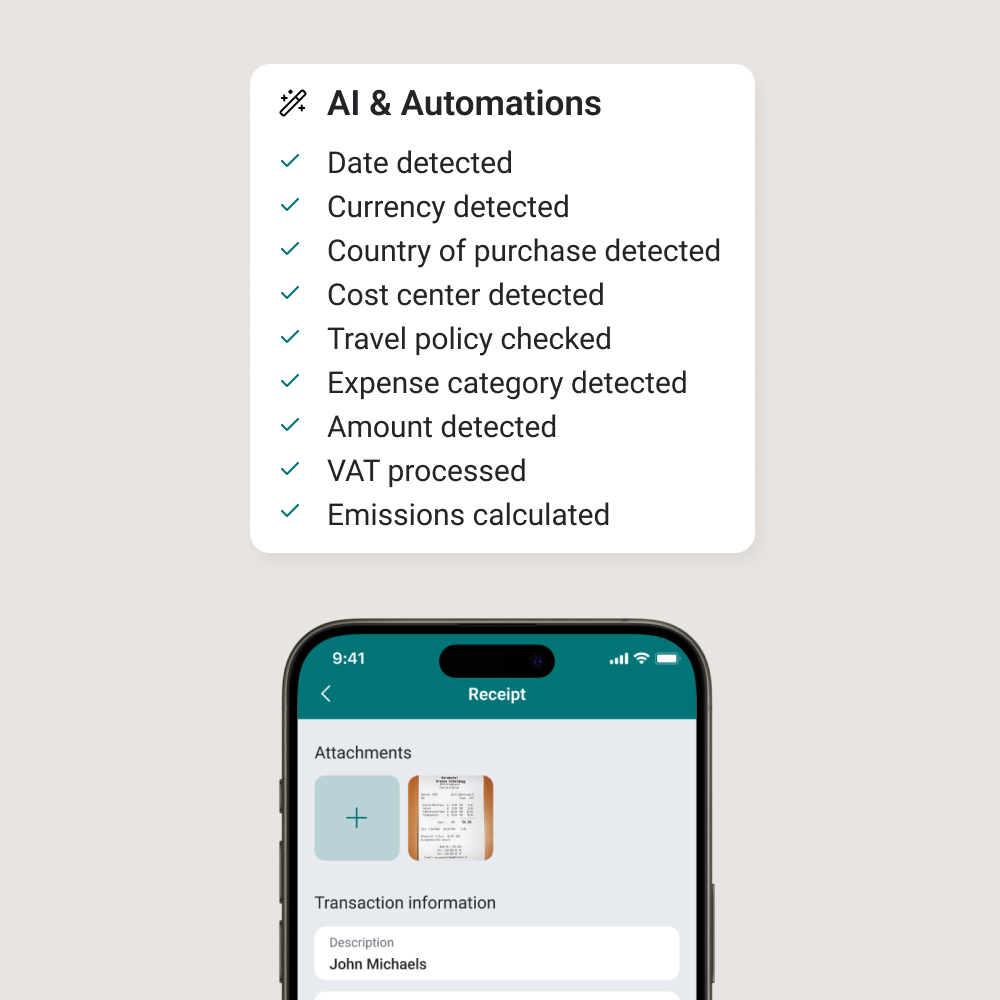
Bezala’s expense management features, including automated mileage tracking and receipt scanning, are designed to capture structured data rather than just amounts, which makes it significantly easier for finance teams to extract the travel records needed for sustainability reporting. When expense data is clean, complete, and consistently categorized, the work of preparing a travel emissions report becomes a data extraction and calculation exercise rather than a data recovery project.
The broader principle is that emissions reporting quality depends almost entirely on the quality of the underlying expense data. Finance teams that treat their expense management system as a sustainability data source, not just a reimbursement tool, are in a far stronger position when reporting deadlines arrive.
This content was generated with the help of AI and it may contain mistakes