

Emission factors for business travel CO2 are standardized coefficients that convert activity data, such as kilometers flown or driven, into equivalent kilograms of CO2 (or CO2e). They are published by government bodies, intergovernmental organizations, and environmental agencies, and they differ by travel mode, fuel type, vehicle class, and geographic region. The sections below unpack where these factors come from, how they are applied, and what businesses need to know when choosing or automating a calculation method.
Where do emission factors for business travel come from?
Emission factors for business travel are drawn from authoritative public sources, primarily the UK Government’s Department for Energy Security and Net Zero (DESNZ), the US Environmental Protection Agency (EPA), the European Environment Agency (EEA), and the Greenhouse Gas Protocol. These bodies compile fuel combustion data, fleet statistics, and lifecycle analyses to produce annually updated emission coefficients organized by travel mode and vehicle type.
The most widely used reference for international business travel is the UK Government’s conversion factor dataset, which covers air, rail, road, and sea travel with granular breakdowns by class and distance band. The Greenhouse Gas Protocol’s guidance documents complement this by providing a methodological framework that organizations use to apply these factors consistently in corporate carbon accounting. Many sustainability platforms and expense tools draw directly from these sources to ensure their calculations align with recognized reporting standards such as GHG Protocol Scope 3, Category 6.
How are CO2 emissions calculated for different travel modes?
CO2 emissions for business travel are calculated by multiplying the distance traveled by the relevant emission factor for that mode, vehicle type, and class. The basic formula is: emissions (kg CO2e) = distance (km or miles) × emission factor (kg CO2e per km). Each travel mode has its own set of factors reflecting differences in fuel efficiency, load assumptions, and fuel type.
Air travel
Flights are segmented by haul length (short, long, and sometimes medium) and cabin class. Business and first class carry higher per-passenger factors than economy because they occupy more physical space per seat, which translates to a larger share of the aircraft’s total emissions. Distance is typically calculated as great-circle distance between airports, sometimes with an uplift factor to account for non-direct routing.
Road and rail travel
For car travel, factors vary by fuel type (petrol, diesel, electric, hybrid) and engine size. Rail factors differ significantly by country because electricity grid carbon intensity varies: a train journey in Sweden produces far fewer emissions per kilometer than the same distance in a country with a coal-heavy grid. Ferry and taxi travel each have their own coefficients, and some frameworks further distinguish between average occupancy assumptions for taxis versus private vehicles.
What is the radiative forcing index and does it affect flight calculations?
The radiative forcing index (RFI) is a multiplier applied to aviation emissions to account for the additional climate warming caused by aircraft at altitude beyond direct CO2 output. Contrails, nitrogen oxides, and water vapor effects at cruising altitude contribute to warming that CO2 alone does not capture. An RFI multiplier of around 1.9 has historically been applied to flight emission factors to reflect this broader impact.
Whether to apply RFI in business travel carbon footprint calculations is genuinely contested. The UK Government’s current guidance publishes both an RFI-adjusted and a non-RFI-adjusted figure, and it recommends that organizations report both transparently rather than selecting one. The Greenhouse Gas Protocol does not mandate RFI inclusion in its Scope 3 guidance. For companies reporting under frameworks such as CDP or science-based targets, it is worth confirming which convention their chosen framework requires before locking in a calculation method.
Why do emission factors differ between providers and years?
Emission factors differ between providers and years because they reflect real-world changes in fleet fuel efficiency, energy grid composition, vehicle electrification rates, and updated measurement science. A factor published in 2020 for a diesel car may be meaningfully different from the 2026 equivalent because average fleet efficiency has improved and the calculation methodology may have been refined.
Provider differences arise from several sources. Some tools use the UK DESNZ dataset while others use EPA or EEA figures, which are calibrated to different national fleets and energy grids. Scope of inclusion also varies: some providers include well-to-wheel emissions (covering fuel extraction and refining), while others use only tank-to-wheel figures (direct combustion only). This means two organizations using different providers can report materially different carbon figures for identical journeys, which complicates supplier comparisons and consolidated reporting across multinational teams.
Should businesses use market-based or location-based emission factors?
For business travel specifically, the market-based versus location-based distinction applies primarily to rail and electric vehicle travel, not to flights. Market-based factors allow organizations to reflect the actual electricity supply they or their transport provider have contracted, for example, a rail operator purchasing renewable energy certificates. Location-based factors use the average carbon intensity of the regional grid regardless of procurement choices.
The GHG Protocol recommends reporting both methods for Scope 2 electricity, and the same logic extends to Scope 3 travel emissions involving electricity consumption. In practice, most companies default to location-based factors for travel because verifying a transport provider’s specific energy procurement is complex. Market-based reporting becomes more relevant when a business is leasing electric vehicles or when a rail provider has credible renewable energy certification that can be passed through to the traveler’s footprint. For air travel, no equivalent market-based mechanism currently exists at the emission factor level, though sustainable aviation fuel (SAF) blending is an emerging area where this may change.
How does expense management software automate CO2 calculations from travel data?
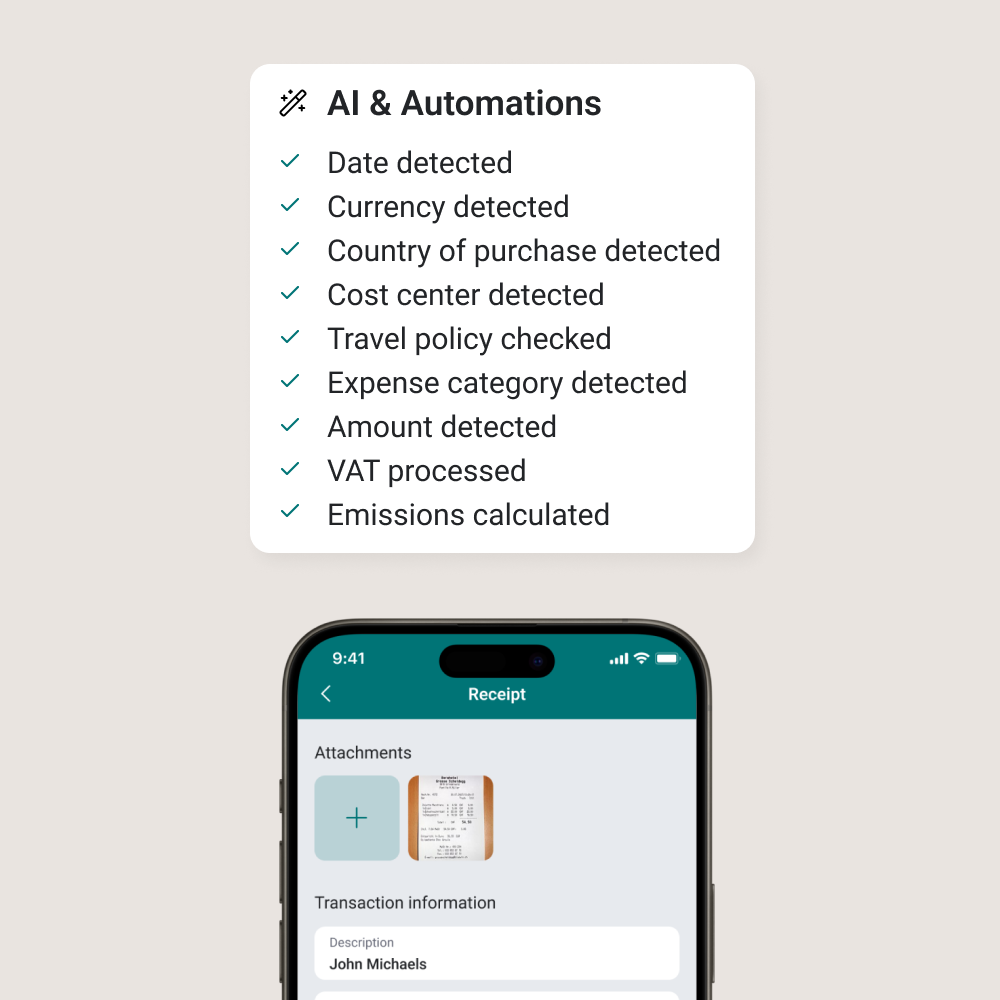
Expense management software automates CO2 calculations by extracting travel data directly from submitted expenses, flight itineraries, mileage claims, rail tickets, and applying the appropriate emission factor in the background without requiring employees to perform any manual calculation. The platform maps each expense category to a travel mode, pulls distance or route data, and multiplies by the current emission factor to produce a per-trip and aggregate carbon figure.
The quality of automation depends on how granularly the software captures travel data. A platform that records only a total spend amount cannot calculate emissions accurately; one that captures origin, destination, cabin class, and vehicle type can apply the correct factor from a recognized dataset. Bezala’s expense platform captures structured travel data including mileage via an integrated map feature, which provides the precise distance inputs that accurate carbon calculations require. When this data flows automatically into reporting, finance teams can track the business travel carbon footprint across the organization without relying on employees to self-report emissions, reducing both administrative burden and the risk of inconsistent calculation methods across a distributed workforce.
This content was generated with the help of AI and it may contain mistakes